 Money Facts To Know
On $9,400 in hand, a fictional 10% loan costs more than 13%
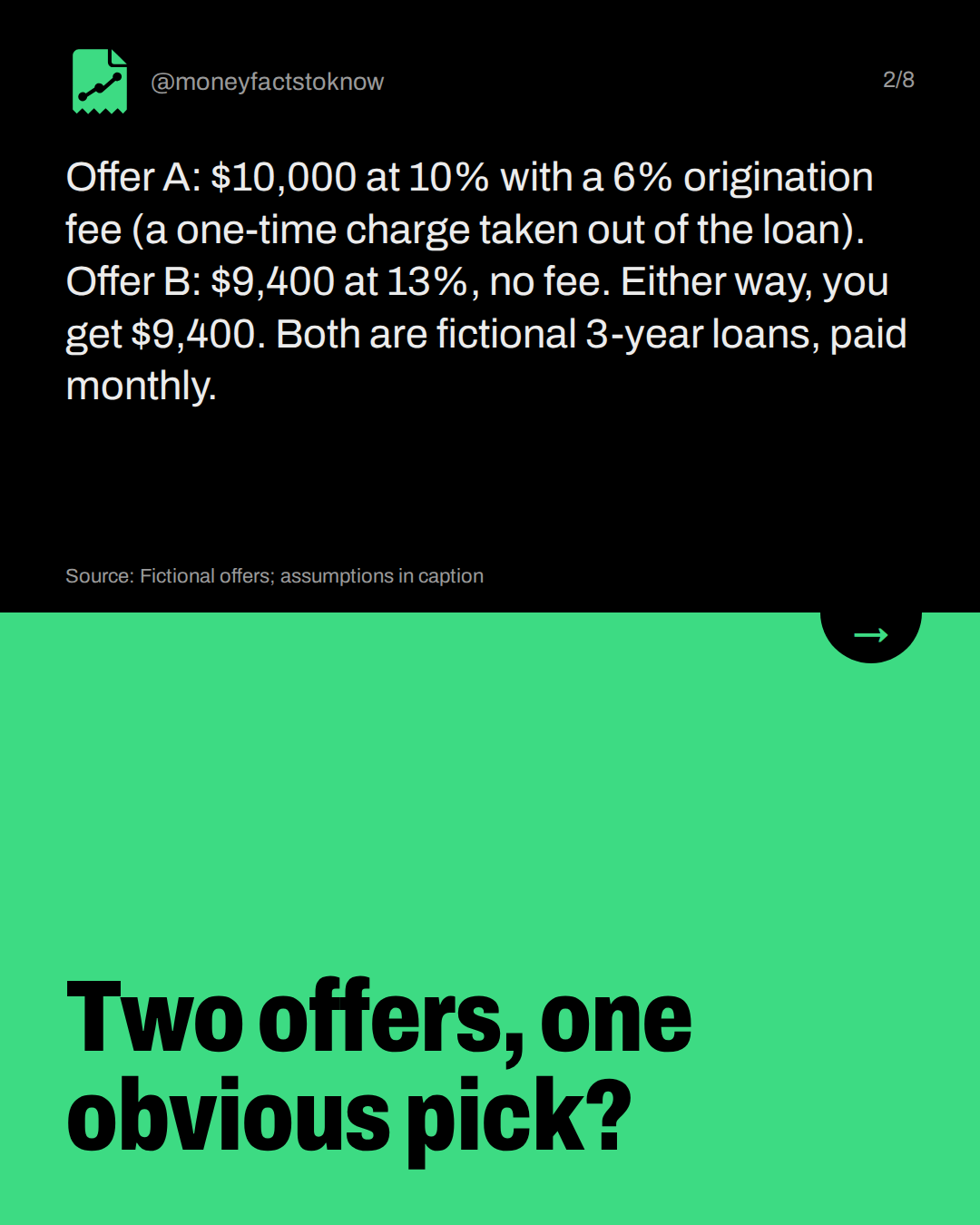
Two offers, one obvious pick?
Offer A: $10,000 at 10% with a 6% origination fee (a one-time charge taken out of the loan). Offer B: $9,400 at 13%, no fee. Either way, you get $9,400. Both are fictional 3-year loans, paid monthly.
Source: Fictional offers; assumptions in caption
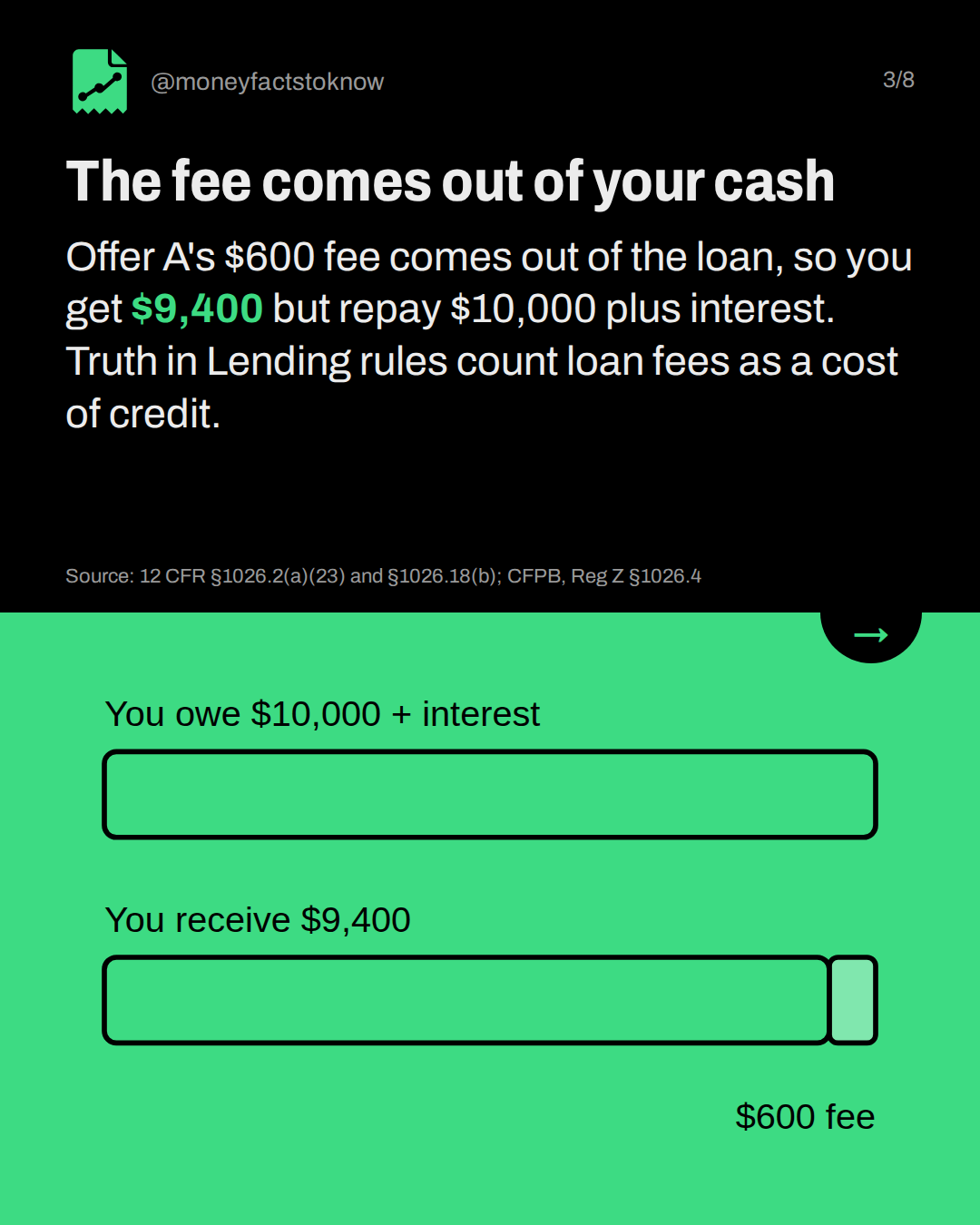
The fee comes out of your cash
Offer A's $600 fee comes out of the loan, so you get $9,400 but repay $10,000 plus interest. Truth in Lending rules count loan fees as a cost of credit.
Source: 12 CFR §1026.2(a)(23) and §1026.18(b); CFPB, Reg Z §1026.4
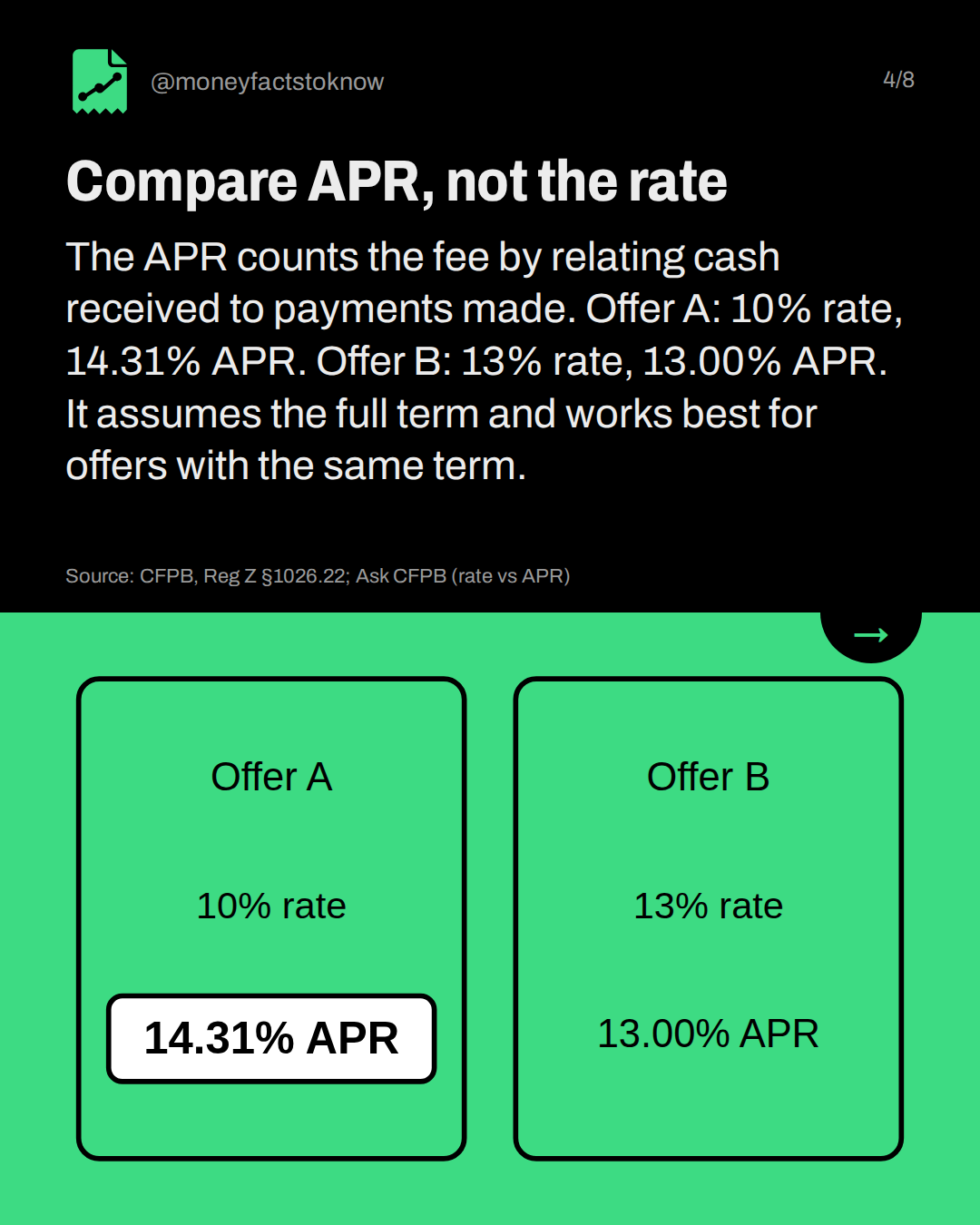
Compare APR, not the rate
The APR counts the fee by relating cash received to payments made. Offer A: 10% rate, 14.31% APR. Offer B: 13% rate, 13.00% APR. It assumes the full term and works best for offers with the same term.
Source: CFPB, Reg Z §1026.22; Ask CFPB (rate vs APR)
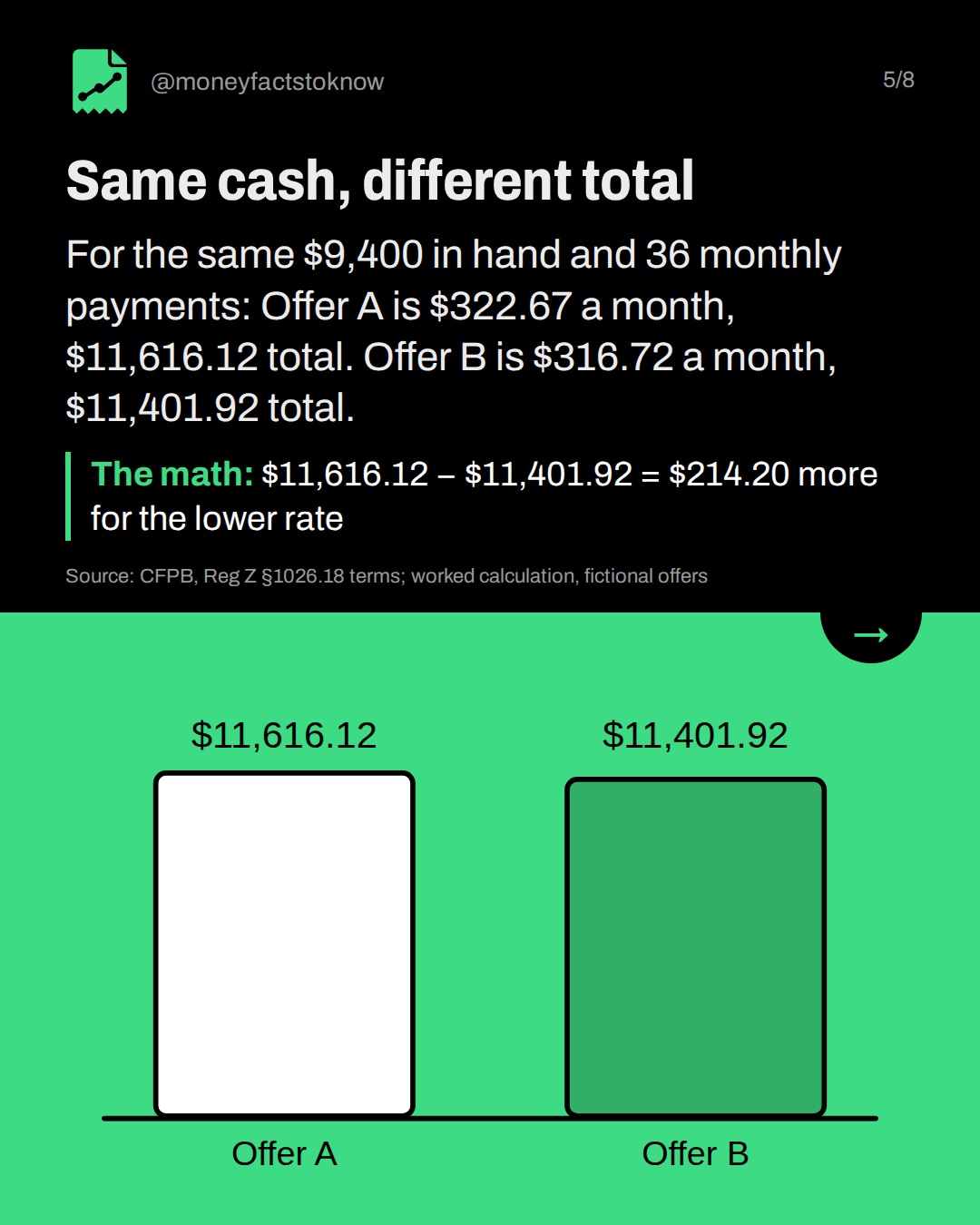
Same cash, different total
For the same $9,400 in hand and 36 monthly payments: Offer A is $322.67 a month, $11,616.12 total. Offer B is $316.72 a month, $11,401.92 total.
The math: $11,616.12 − $11,401.92 = $214.20 more for the lower rate
Source: CFPB, Reg Z §1026.18 terms; worked calculation, fictional offers
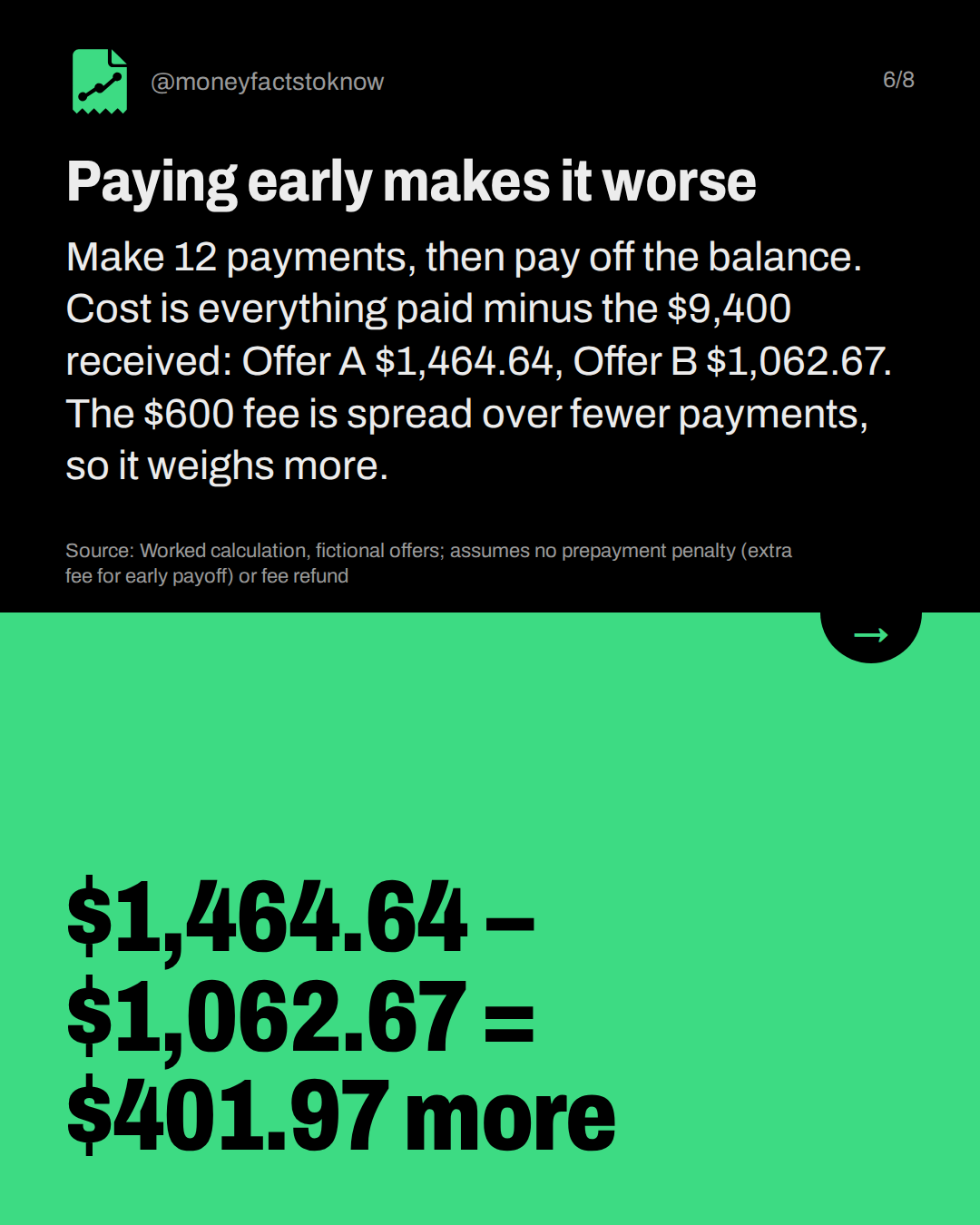
Paying early makes it worse
Make 12 payments, then pay off the balance. Cost is everything paid minus the $9,400 received: Offer A $1,464.64, Offer B $1,062.67. The $600 fee is spread over fewer payments, so it weighs more.
The math: $1,464.64 − $1,062.67 = $401.97 more
Source: Worked calculation, fictional offers; assumes no prepayment penalty (extra fee for early payoff) or fee refund
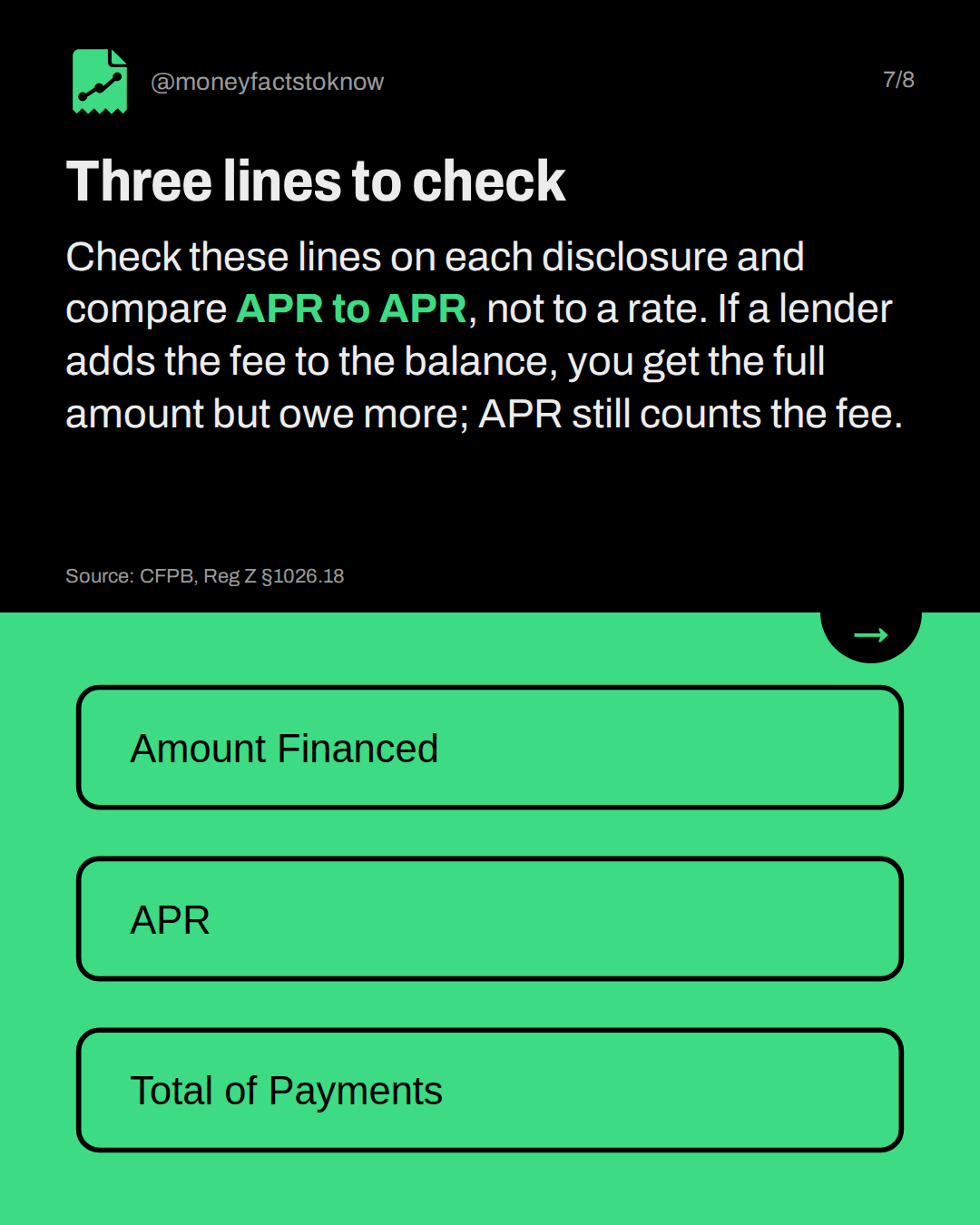
Three lines to check
Check these lines on each disclosure and compare APR to APR, not to a rate. If a lender adds the fee to the balance, you get the full amount but owe more; APR still counts the fee.
Source: CFPB, Reg Z §1026.18
Sources and assumptions
- CFPB, Regulation Z §1026.4 Finance charge: The finance charge is the cost of consumer credit as a dollar amount; §1026.4(b)(3) lists 'points, loan fees, assumption fees, finder's fees, and similar charges' as finance charges (checked 2026-10-10)
- CFPB, Regulation Z §1026.18 Content of disclosures: Closed-end loans must disclose Amount Financed ('the amount of credit provided to you or on your behalf'), Finance Charge ('the dollar amount the credit will cost you'), APR ('the cost of your credit as a yearly rate') and Total of Payments (checked 2026-10-10)
- 12 CFR §1026.18(b), Cornell LII: Amount financed is calculated by subtracting any prepaid finance charge from the principal (checked 2026-10-10)
- 12 CFR §1026.2(a)(23), Cornell LII: A prepaid finance charge includes any finance charge 'withheld from the proceeds of the credit at any time', which covers an origination fee taken out of the loan (checked 2026-10-10)
- 12 CFR §1026.22, Cornell LII: APR is 'a measure of the cost of credit, expressed as a yearly rate, that relates the amount and timing of value received by the consumer to the amount and timing of payments made'; it counts as accurate within 1/8 of a percentage point (checked 2026-10-10)
- CFPB, What is the difference between a loan interest rate and the APR?: APR is the interest rate plus additional fees charged with the loan; compare APRs to APRs, not to interest rates (the page is written for auto loans, last reviewed Aug 28, 2026) (checked 2026-10-10)
Assumptions:
- Both offers are fictional personal installment loans: 36 monthly payments, fixed rate, interest compounded monthly at rate/12, standard amortization
- Offer A: $10,000 principal at 10%, with a 6% ($600) origination fee taken out of the proceeds, so the borrower receives $9,400
- Offer B: $9,400 principal at 13%, no fees, so the borrower receives the same $9,400
- Monthly payments rounded to the cent; the small final-payment rounding adjustment is ignored
- No other fees, no late payments, no prepayment penalty, fee not refunded on early payoff
- APR worked out the way Reg Z defines it: the rate at which the 36 payments, discounted, equal the cash received (amount financed)
- Early-payoff example: 11 regular payments, then the 12th payment plus the remaining balance in month 12
The short version
- A lower rate can still cost more
- A fee taken out means less cash to you
- The APR counts the fee
- Compare APR and total dollars


