 Money Facts To Know
Same $5,000 gain, sold one day apart: $1,100 or $750 in tax
A gain isn't always one kind
Many people treat a gain as a gain. Federal tax splits gains by how long you held the asset: one year or less is short-term, more than one year is long-term.
Source: IRS Topic 409
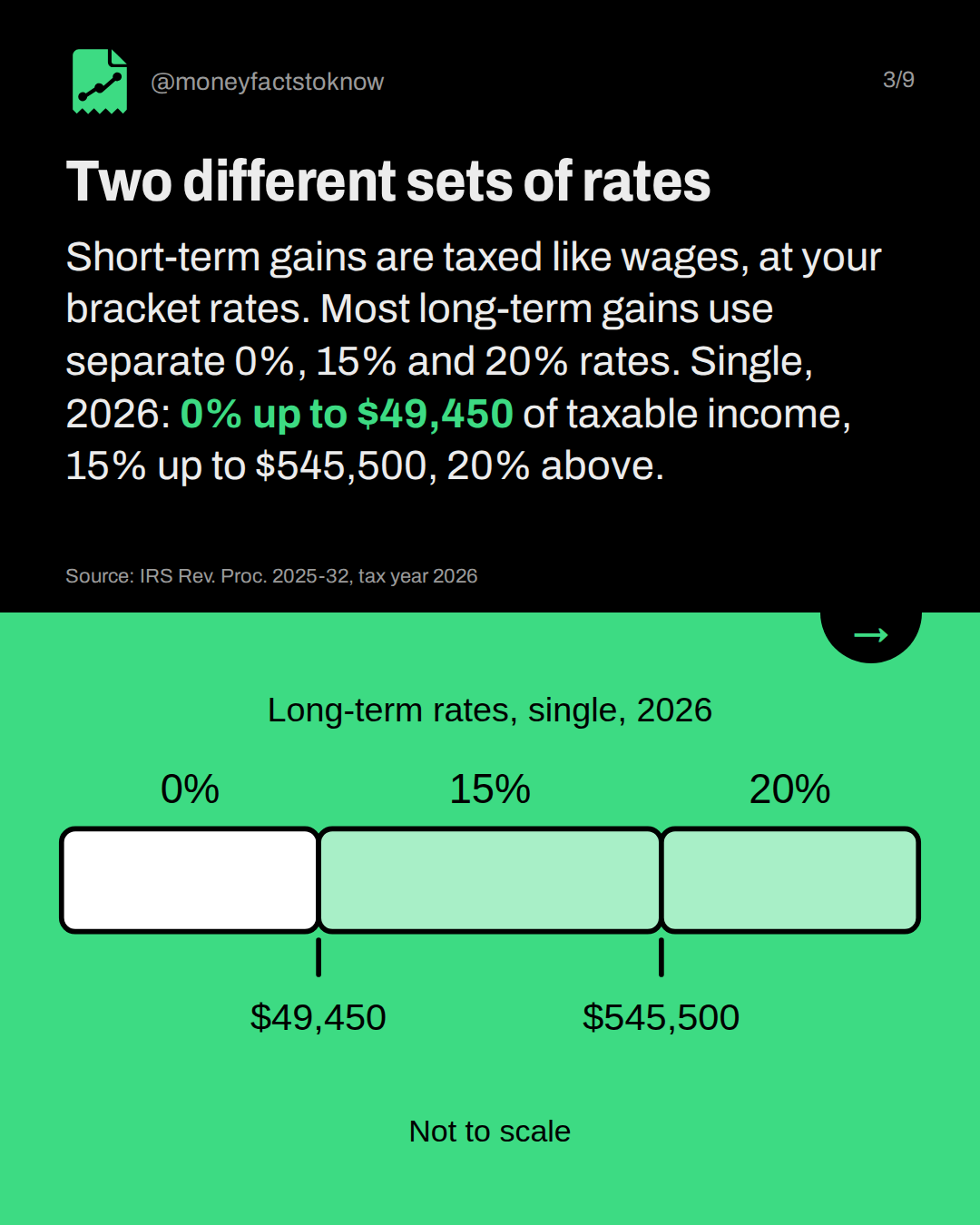
Two different sets of rates
Short-term gains are taxed like wages, at your bracket rates. Most long-term gains use separate 0%, 15% and 20% rates. Single, 2026: 0% up to $49,450 of taxable income, 15% up to $545,500, 20% above.
Source: IRS Rev. Proc. 2025-32, tax year 2026
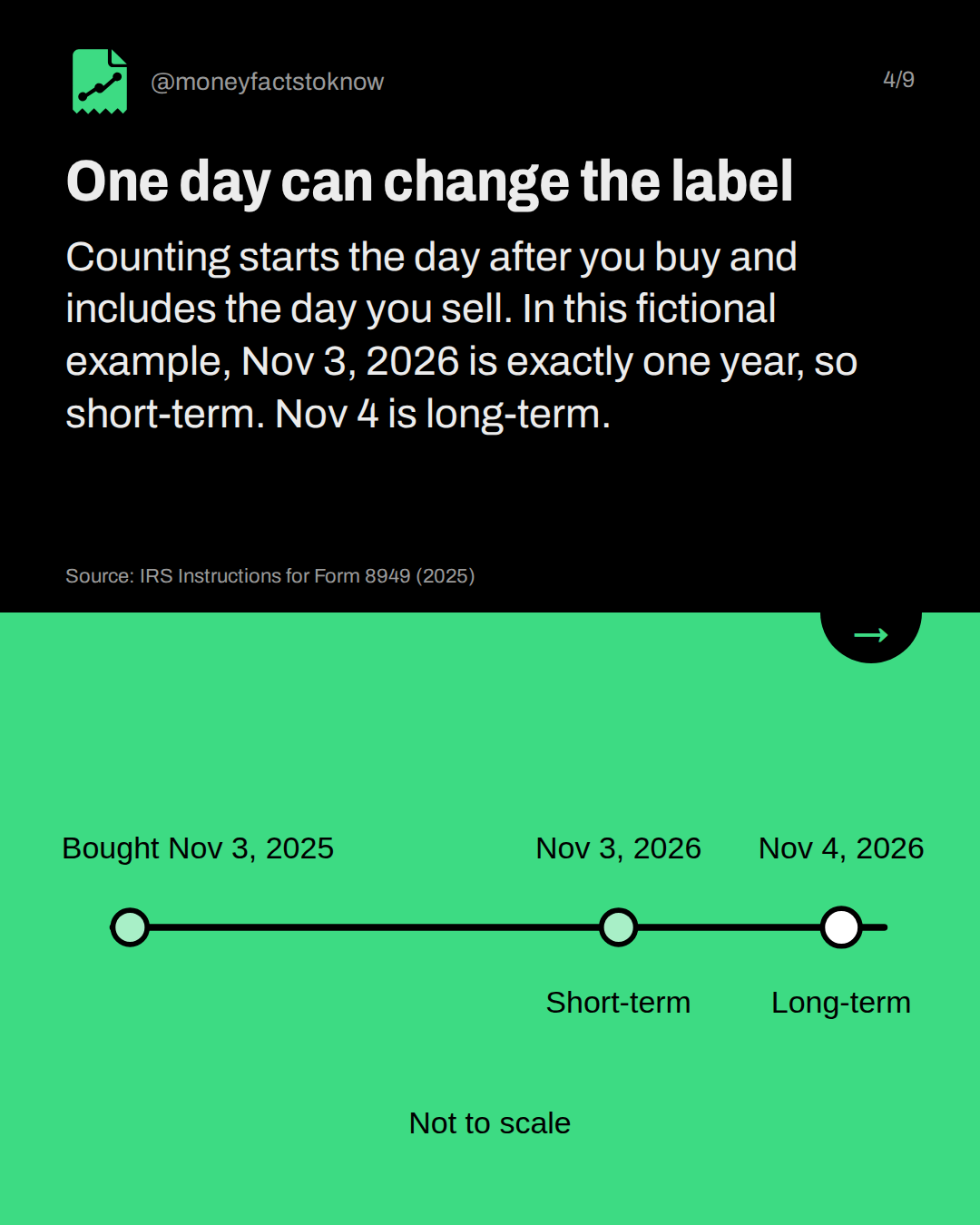
One day can change the label
Counting starts the day after you buy and includes the day you sell. In this fictional example, Nov 3, 2026 is exactly one year, so short-term. Nov 4 is long-term.
Source: IRS Instructions for Form 8949 (2025)
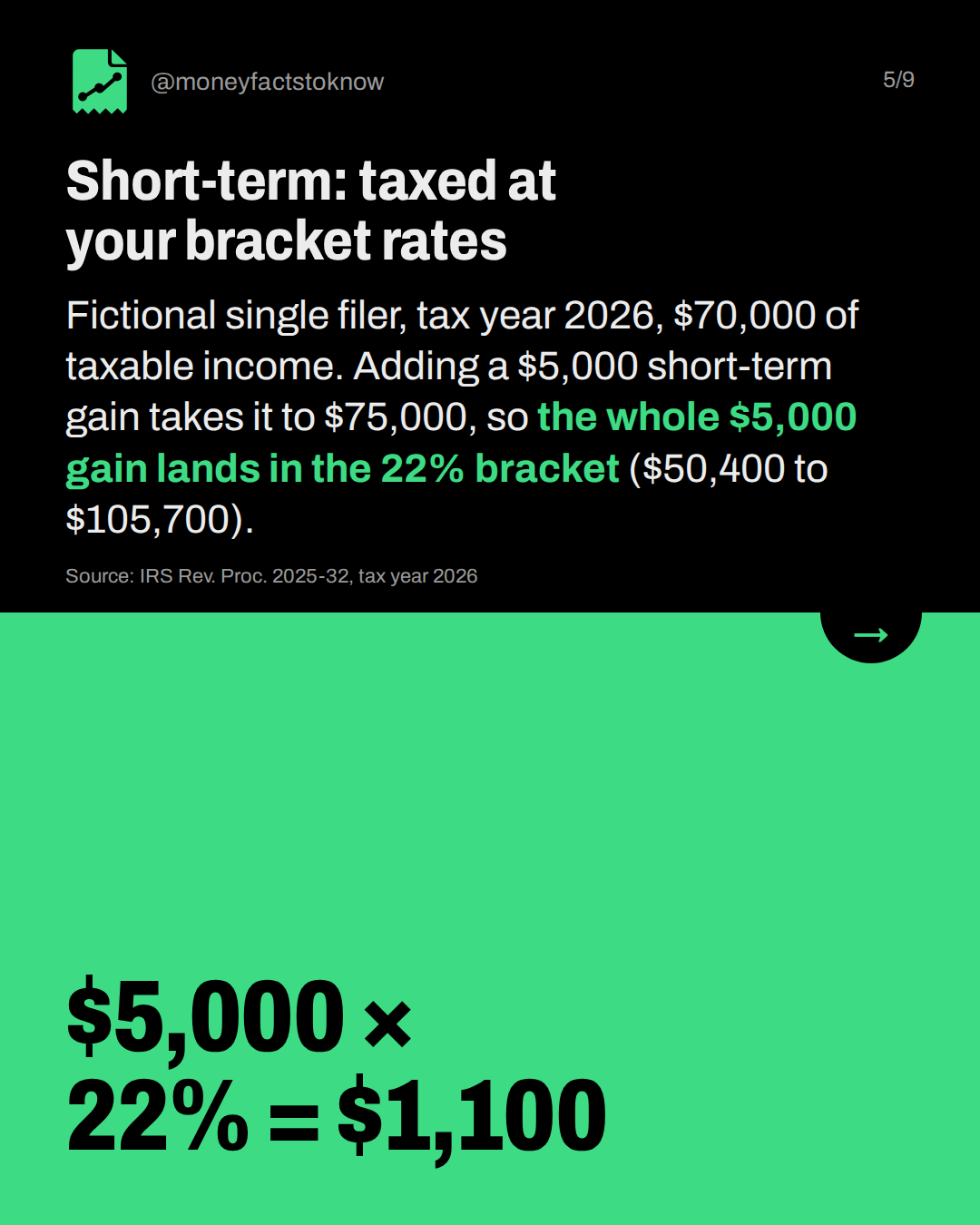
Short-term: taxed at your bracket rates
Fictional single filer, tax year 2026, $70,000 of taxable income. Adding a $5,000 short-term gain takes it to $75,000, so the whole $5,000 gain lands in the 22% bracket ($50,400 to $105,700).
The math: $5,000 × 22% = $1,100
Source: IRS Rev. Proc. 2025-32, tax year 2026
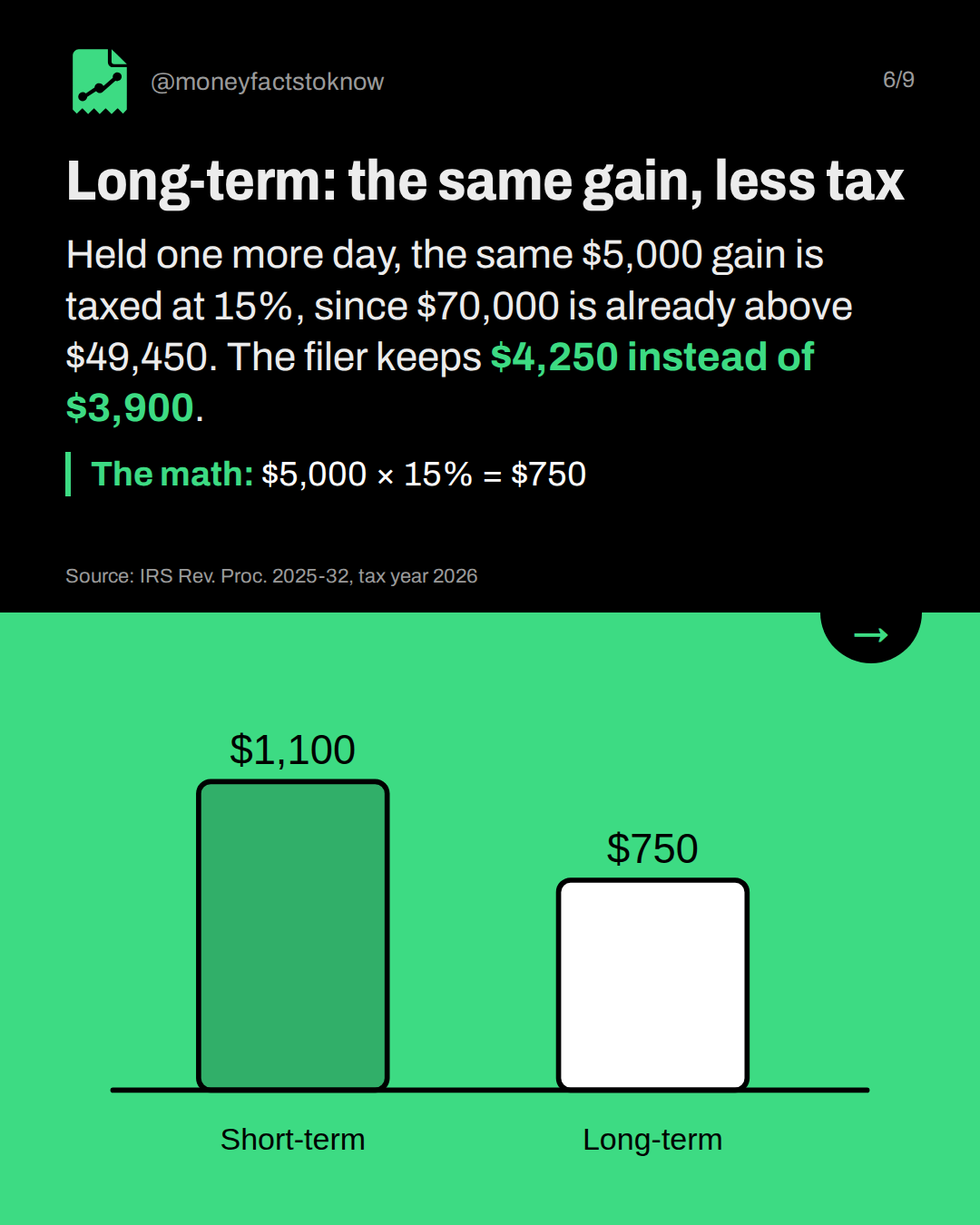
Long-term: the same gain, less tax
Held one more day, the same $5,000 gain is taxed at 15%, since $70,000 is already above $49,450. The filer keeps $4,250 instead of $3,900.
The math: $5,000 × 15% = $750
Source: IRS Rev. Proc. 2025-32, tax year 2026
When this example stops applying
In this fictional $15,000 position, a price drop of about $412 (about 2.7% of its value) erases the $350 difference. Other gains, losses or state tax change the math; income under $49,450 can mean 0%.
Source: IRS Rev. Proc. 2025-32, tax year 2026; our calculation

What to check before selling
Check the purchase date on your brokerage's cost-basis page. Long-term starts the day after the one-year anniversary (Nov 3, 2025 → Nov 4, 2026). Compare your taxable income, including the gain, with $49,450 and $545,500 (single, 2026).
Source: IRS Rev. Proc. 2025-32, tax year 2026
Sources and assumptions
- IRS Topic no. 409, Capital gains and losses: Held more than one year = long-term, one year or less = short-term; net short-term gains are taxed as ordinary income at graduated rates; long-term rates are 0%, 15% and 20%; refers to the NIIT (checked 2026-10-09)
- IRS Rev. Proc. 2025-32 (tax year 2026 inflation adjustments), sections 3.01 Table 3 and 3.03: 2026 unmarried individuals: 12% up to $50,400; 22% over $50,400 up to $105,700 ($5,800 plus 22% of the excess); maximum zero rate amount $49,450 and maximum 15% rate amount $545,500 for 'All Other Individuals' (single); MFJ $98,900/$613,700; HOH $66,200/$579,600; standard deduction single $16,100 (checked 2026-10-09)
- IRS newsroom: tax inflation adjustments for tax year 2026: 2026 single brackets (22% over $50,400, 24% over $105,700) and the $16,100 single standard deduction, matching Rev. Proc. 2025-32 (checked 2026-10-09)
- IRS Instructions for Form 8949 (2025), Short-Term or Long-Term: 'To figure the holding period, begin counting on the day after you received the property and include the day you disposed of it.' One year or less = short-term, more than one year = long-term (checked 2026-10-09)
- IRS Topic no. 559, Net investment income tax: 3.8% NIIT on the lesser of net investment income or MAGI over $200,000 for single filers (checked 2026-10-09)
Assumptions:
- The filer is fictional: single, tax year 2026, US federal tax only
- $70,000 of taxable income from wages AFTER the standard deduction, before the gain
- $5,000 gain from fictional shares bought for $10,000 and now worth $15,000; same price on both sale dates in the main comparison
- No other capital gains or losses in 2026, no state income tax counted
- MAGI is well under $200,000, so no net investment income tax
- Purchase date Nov 3, 2025 is fictional; sale dates are Nov 3, 2026 (short-term) and Nov 4, 2026 (long-term)
- The break-even price drop assumes the sale is still at a gain and taxed at 15%
The short version
- One year or less is short-term.
- More than one year is long-term.
- Short-term gains are taxed like wages, at bracket rates.
- Fictional single, $70,000 income, 2026: $1,100 vs $750.


