 Money Facts To Know
First payment, $1,896 on a fictional 30-year, 6.5% loan: only $271 off
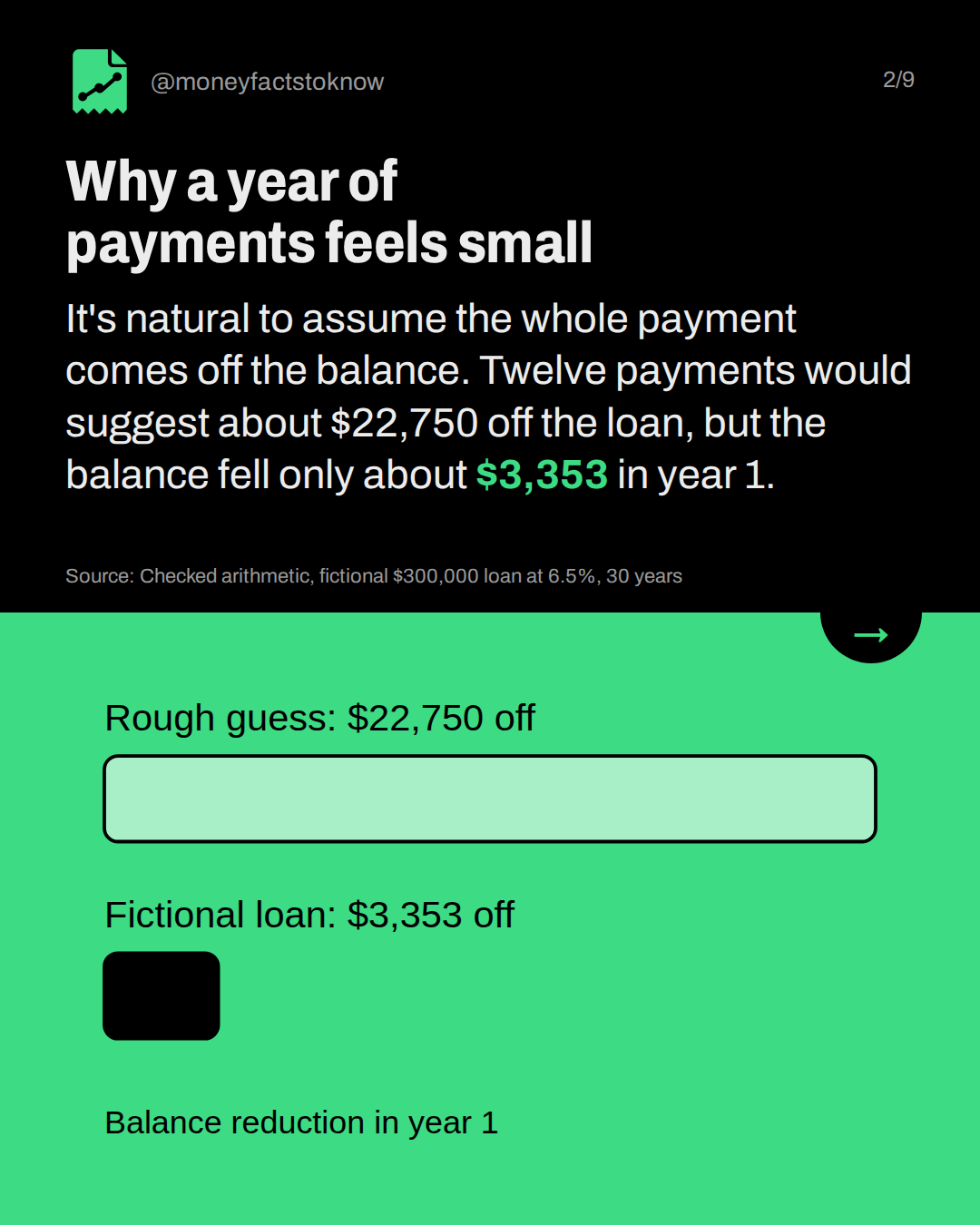
Why a year of payments feels small
It's natural to assume the whole payment comes off the balance. Twelve payments would suggest about $22,750 off the loan, but the balance fell only about $3,353 in year 1.
Source: Checked arithmetic, fictional $300,000 loan at 6.5%, 30 years
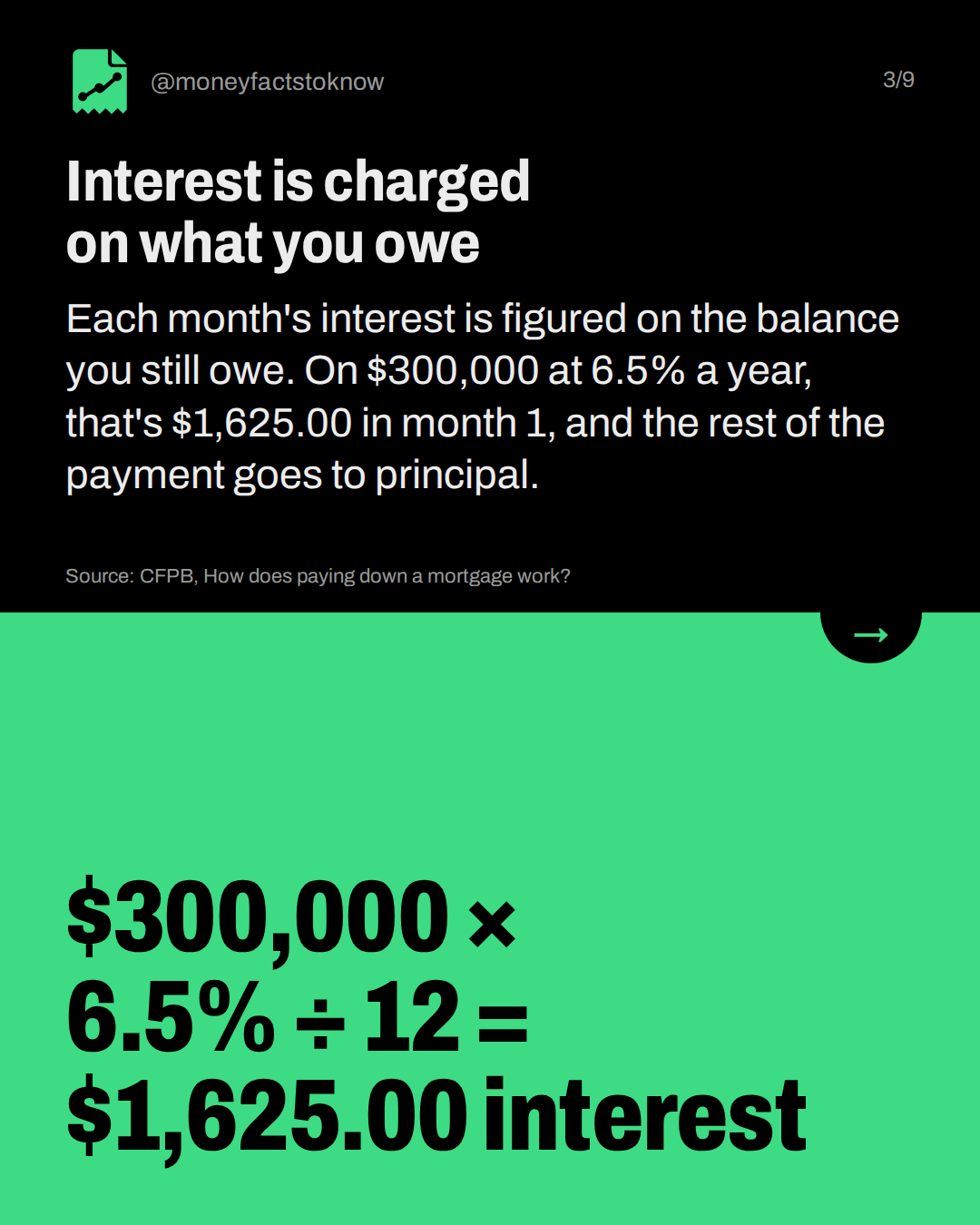
Interest is charged on what you owe
Each month's interest is figured on the balance you still owe. On $300,000 at 6.5% a year, that's $1,625.00 in month 1, and the rest of the payment goes to principal.
The math: $300,000 × 6.5% ÷ 12 = $1,625.00 interest
Source: CFPB, How does paying down a mortgage work?
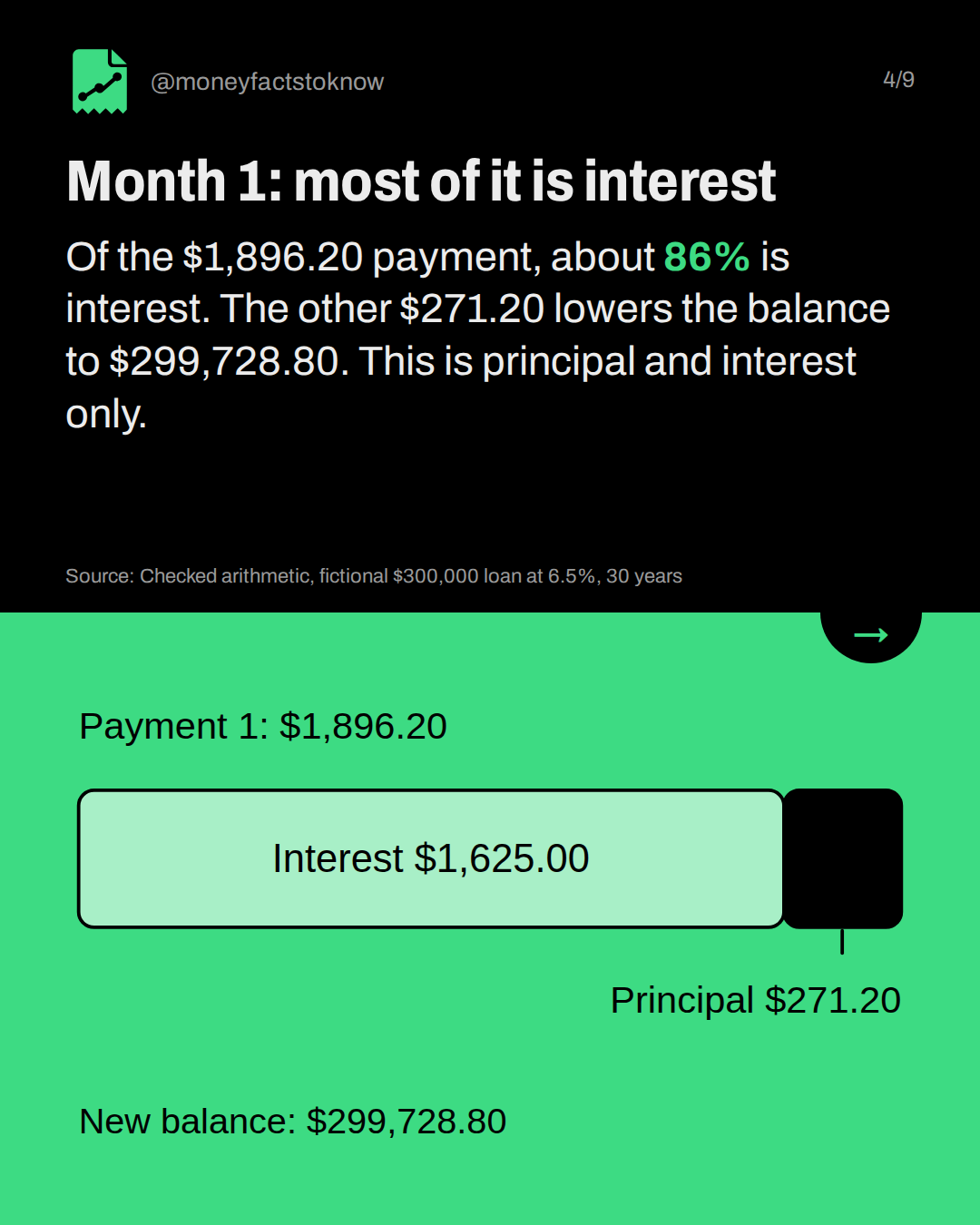
Month 1: most of it is interest
Of the $1,896.20 payment, about 86% is interest. The other $271.20 lowers the balance to $299,728.80. This is principal and interest only.
Source: Checked arithmetic, fictional $300,000 loan at 6.5%, 30 years
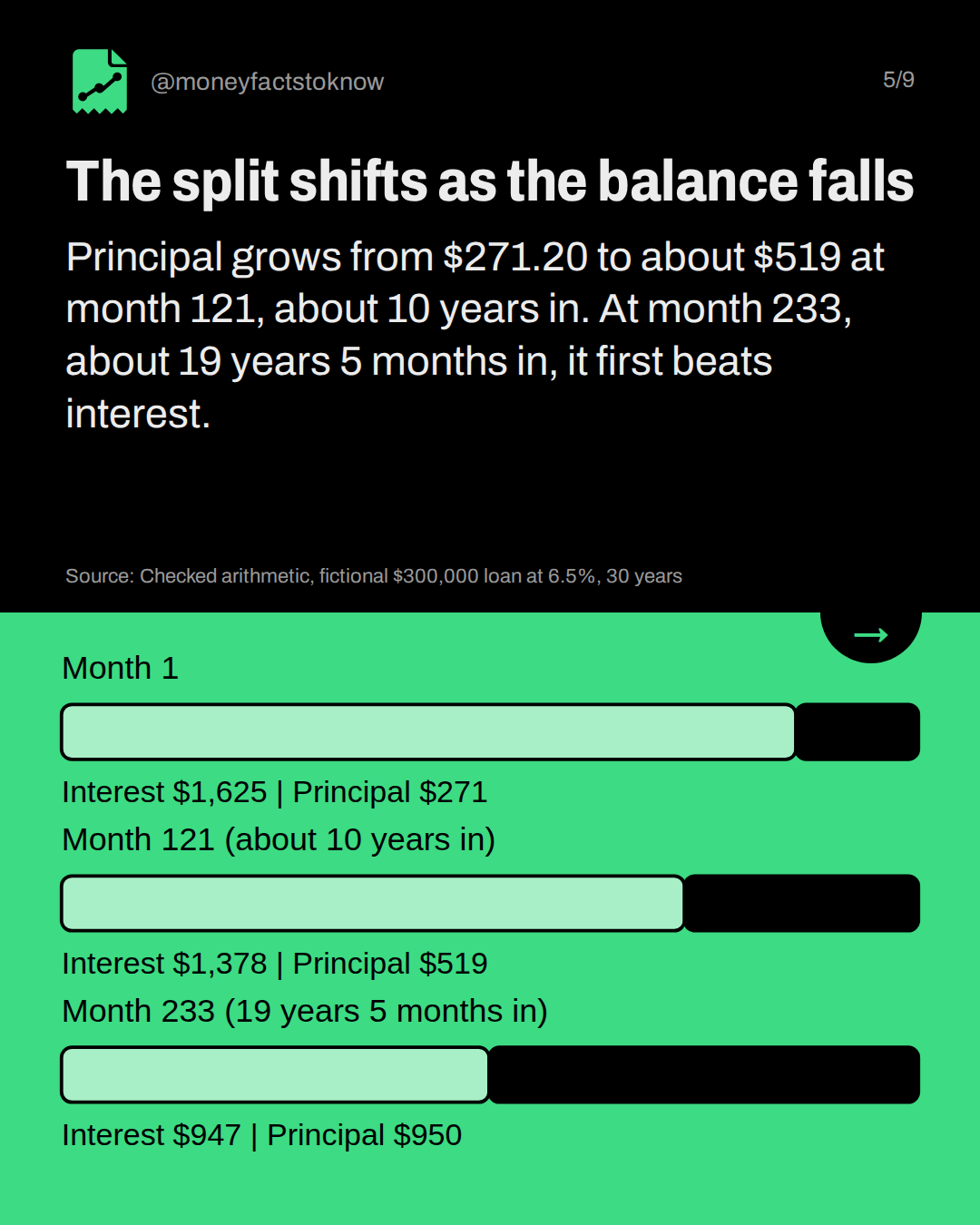
The split shifts as the balance falls
Principal grows from $271.20 to about $519 at month 121, about 10 years in. At month 233, about 19 years 5 months in, it first beats interest.
Source: Checked arithmetic, fictional $300,000 loan at 6.5%, 30 years
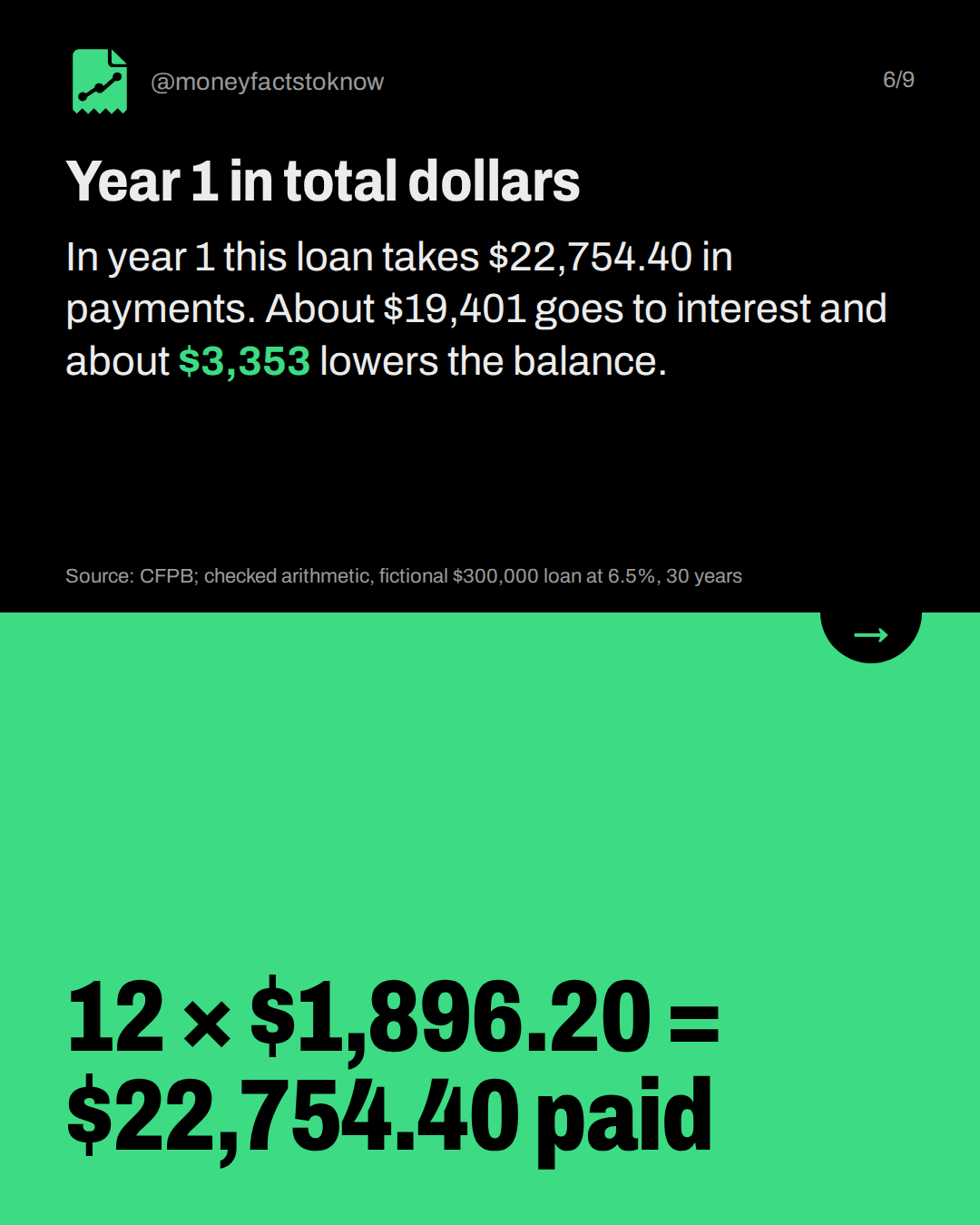
Year 1 in total dollars
In year 1 this loan takes $22,754.40 in payments. About $19,401 goes to interest and about $3,353 lowers the balance.
The math: 12 × $1,896.20 = $22,754.40 paid
Source: CFPB; checked arithmetic, fictional $300,000 loan at 6.5%, 30 years
When this example stops applying
Adjustable-rate loans, a different rate or term, and extra principal payments all change the split. Escrow for taxes and insurance is added on top of the $1,896.20. Your first statement can differ if interest accrues daily.
Source: CFPB, How does paying down a mortgage work? (reviewed May 28, 2024); fictional $300,000 loan at 6.5%, 30 years
What to check on your statement
Most mortgage statements must show how your payment splits between principal, interest and escrow. Look at the principal line, not just the amount due, and compare it with an amortization schedule from your servicer or your loan documents.
Source: CFPB, Regulation Z §1026.41
Sources and assumptions
- CFPB, How does paying down a mortgage work? (last reviewed May 28, 2024): On a typical fixed-rate loan, the combined principal and interest payment stays the same, but the split changes. Early on, most of the payment goes to interest because the balance is high. Over time more goes to principal. Lenders use a standard formula so the loan pays off at the end of the term. Payments often also include amounts for taxes and insurance. (checked 2026-10-09)
- CFPB, Regulation Z §1026.41 Periodic statements for residential mortgage loans: §1026.41(d)(2)(i): the periodic statement must show the monthly payment amount with a breakdown of how much goes to principal, interest and escrow. §1026.41(d)(3)(i): payments received since the last statement must also be broken down. (Small servicers and some other loans are exempt under §1026.41(e).) (checked 2026-10-09)
Assumptions:
- Fictional loan: $300,000 borrowed, 30-year (360-month) fixed rate, 6.5% annual interest rate, monthly payments.
- Monthly rate = 6.5% ÷ 12. The payment comes from the standard formula P·r / (1 − (1+r)^−n) = $1,896.204…, rounded to $1,896.20.
- Each month's interest = the previous balance × 6.5%/12, rounded to the cent. Principal = $1,896.20 − interest. The final payment absorbs the rounding residue.
- Principal and interest only: no escrow (property tax, homeowners insurance), PMI, fees, or extra payments.
- The month-121 figure comes from the cent-rounded schedule ($518.58). The unrounded closed form gives $518.59, so the slides say 'about $519'.
- This isn't a rate quote. Real loans' rates, terms and servicer rounding differ.
The short version
- Interest is figured on what you still owe.
- Month 1 on the fictional 6.5%, 30-year loan: $1,625.00 interest, $271.20 principal.
- The payment stays the same; the split shifts.
- Check the principal line on your statement.


