 Money Facts To Know
You owe $3,000 at tax time. The penalty can still be $0

A bill isn't the same as a penalty
Many people assume that owing money when they file means a penalty is coming. But a balance due and the underpayment penalty are two separate things, with separate rules.
Source: IRS Topic 306; IRS, Failure to pay penalty
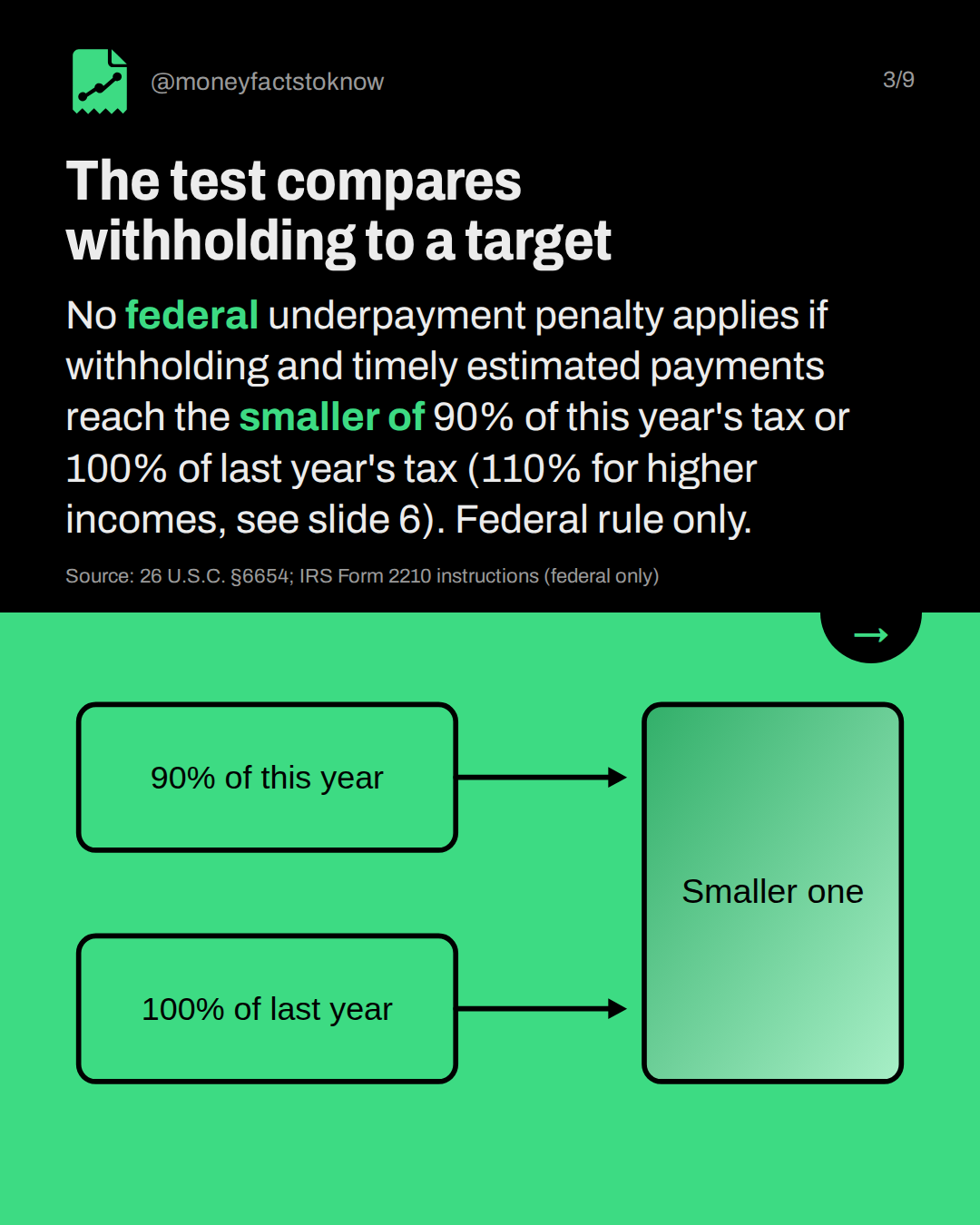
The test compares withholding to a target
No federal underpayment penalty applies if withholding and timely estimated payments reach the smaller of 90% of this year's tax or 100% of last year's tax (110% for higher incomes, see slide 6). Federal rule only.
Source: 26 U.S.C. §6654; IRS Form 2210 instructions (federal only)
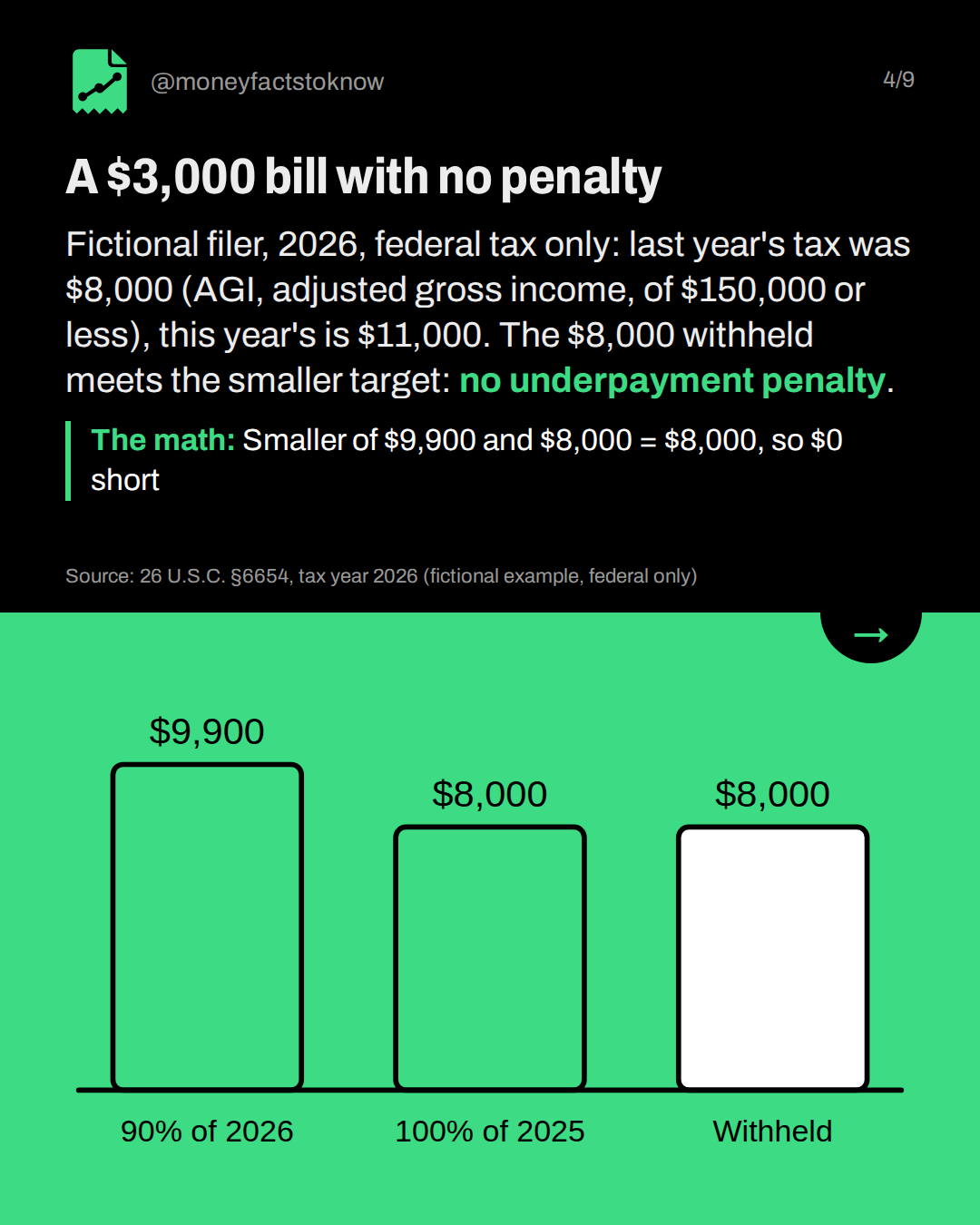
A $3,000 bill with no penalty
Fictional filer, 2026, federal tax only: last year's tax was $8,000 (AGI, adjusted gross income, of $150,000 or less), this year's is $11,000. The $8,000 withheld meets the smaller target: no underpayment penalty.
The math: Smaller of $9,900 and $8,000 = $8,000, so $0 short
Source: 26 U.S.C. §6654, tax year 2026 (fictional example, federal only)
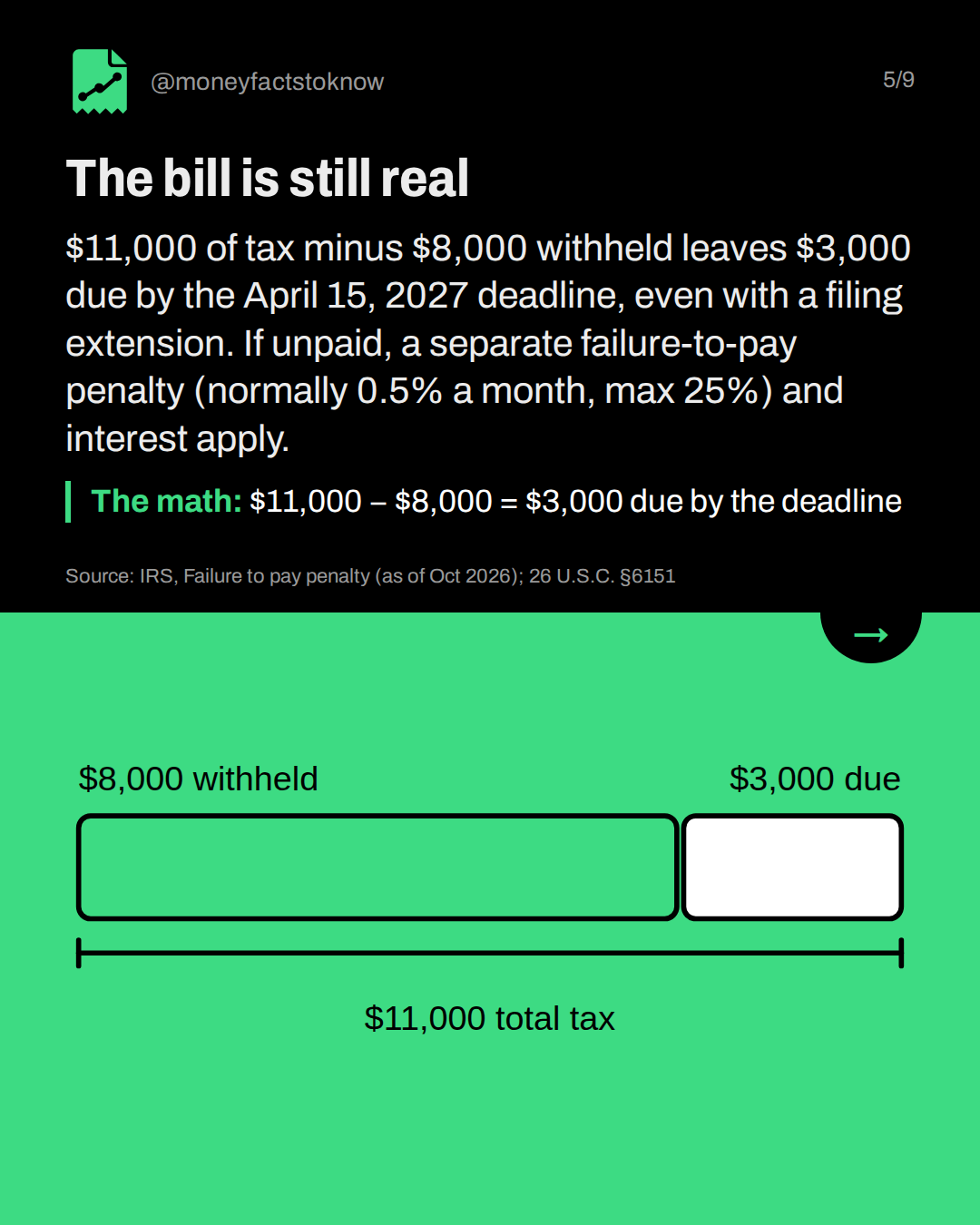
The bill is still real
$11,000 of tax minus $8,000 withheld leaves $3,000 due by the April 15, 2027 deadline, even with a filing extension. If unpaid, a separate failure-to-pay penalty (normally 0.5% a month, max 25%) and interest apply.
The math: $11,000 − $8,000 = $3,000 due by the deadline
Source: IRS, Failure to pay penalty (as of Oct 2026); 26 U.S.C. §6151
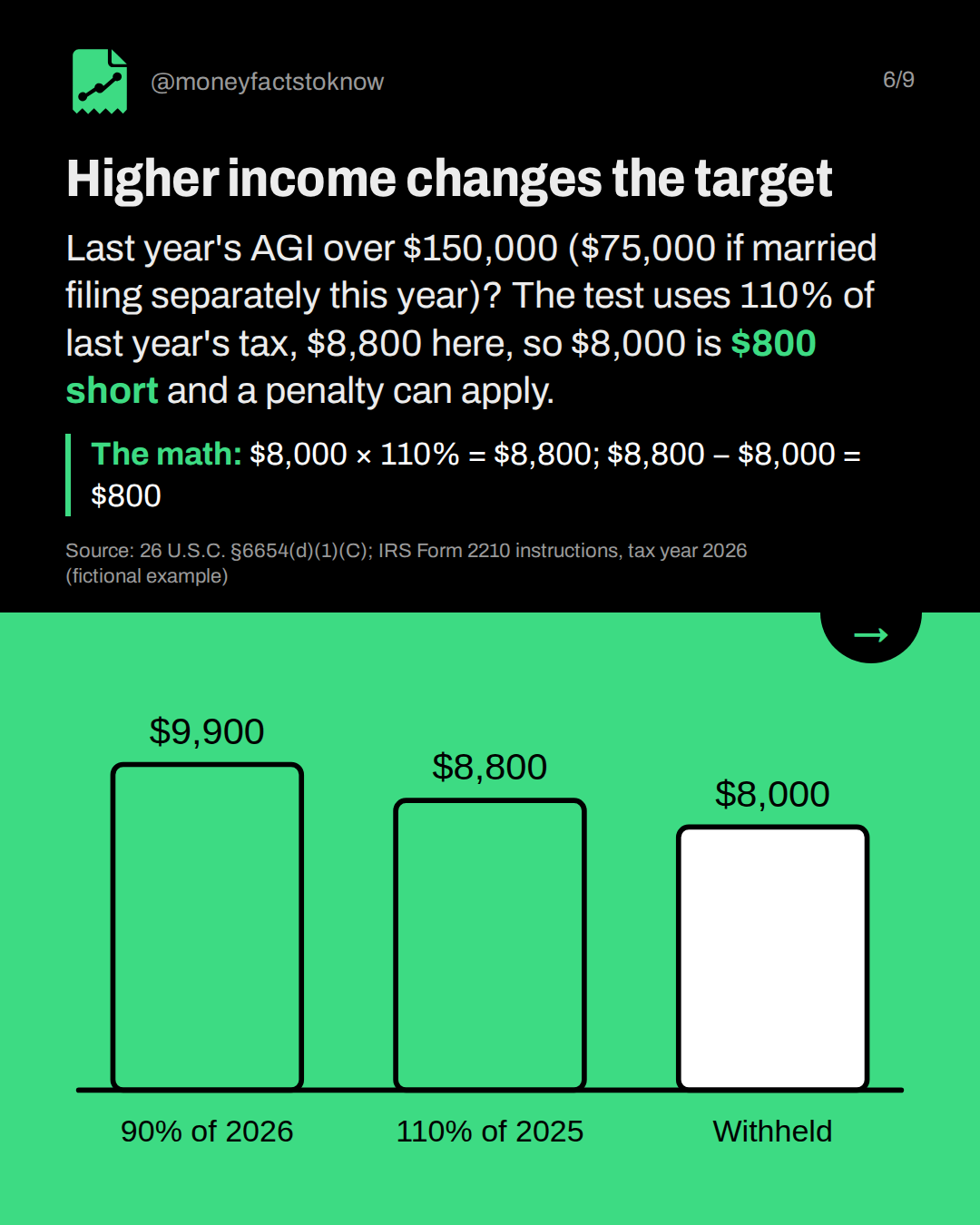
Higher income changes the target
Last year's AGI over $150,000 ($75,000 if married filing separately this year)? The test uses 110% of last year's tax, $8,800 here, so $8,000 is $800 short and a penalty can apply.
The math: $8,000 × 110% = $8,800; $8,800 − $8,000 = $800
Source: 26 U.S.C. §6654(d)(1)(C); IRS Form 2210 instructions, tax year 2026 (fictional example)
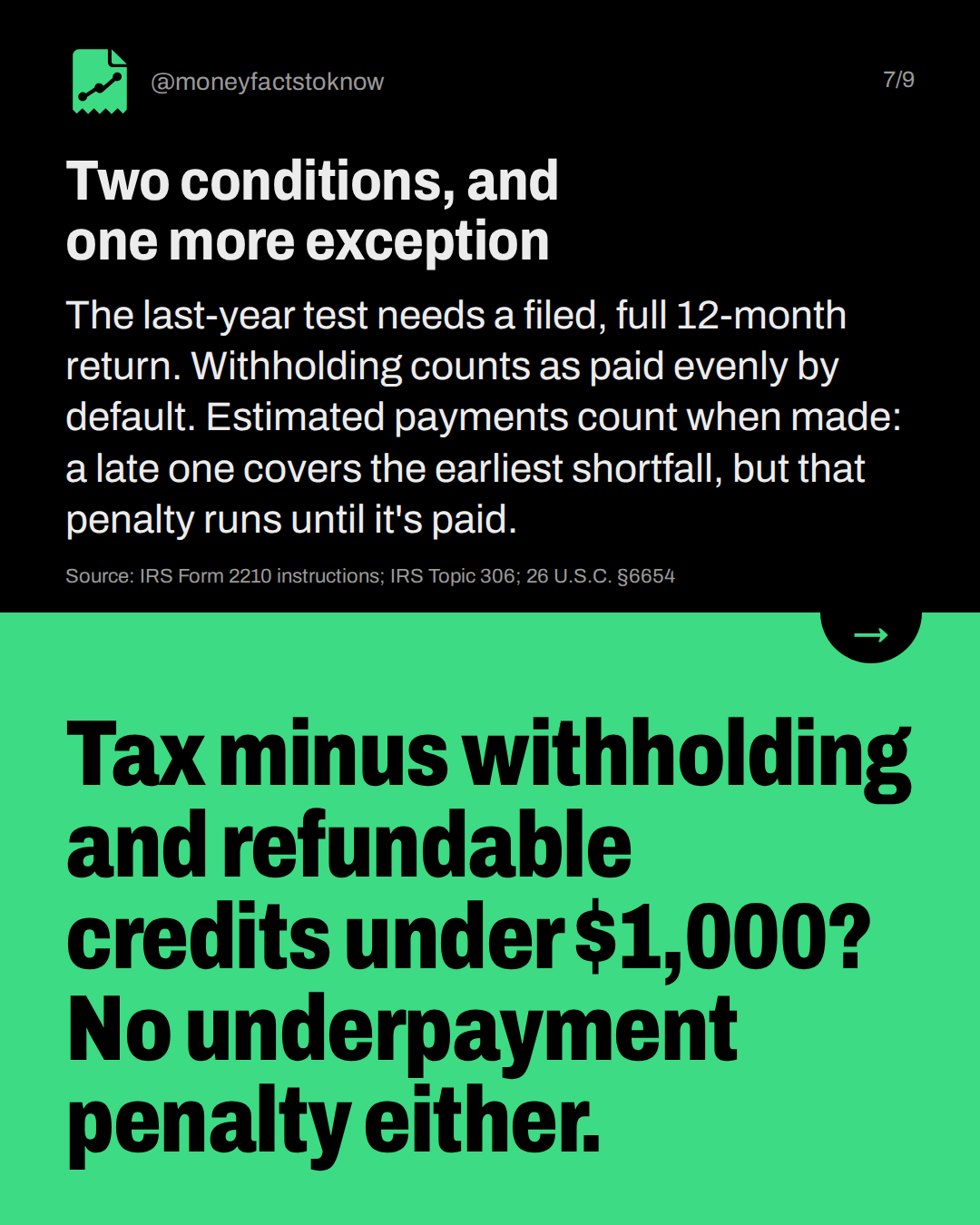
Two conditions, and one more exception
The last-year test needs a filed, full 12-month return. Withholding counts as paid evenly by default. Estimated payments count when made: a late one covers the earliest shortfall, but that penalty runs until it's paid.
The math: Tax minus withholding and refundable credits under $1,000? No underpayment penalty either.
Source: IRS Form 2210 instructions; IRS Topic 306; 26 U.S.C. §6654
What to check on your own return
Find last year's tax as Form 2210 defines it, and estimate 90% of this year's. Is last year's AGI over $150,000 ($75,000 if married filing separately)? Compare the smaller target with your expected withholding plus estimated payments.
Source: 26 U.S.C. §6654(d)(1)(C); IRS Form 2210 instructions
Sources and assumptions
- 26 U.S. Code §6654 (Cornell LII): Required annual payment = lesser of 90% of current-year tax or 100% of prior-year tax. Prior-year test requires a 12-month prior year and a filed return. 110% when prior-year AGI exceeds $150,000 ($75,000 MFS). No penalty if tax minus withholding is under $1,000. Withholding deemed paid in equal parts on each due date. (checked 2026-10-08)
- IRS Instructions for Form 2210 (2025): Smaller of 90% of current tax or 100% of prior tax. 110% if prior-year AGI over $150,000 ($75,000 MFS). Less-than-$1,000 exception. No prior-year test if the prior year was under 12 months. Withholding treated as one-fourth paid on each due date. Penalty figured separately for each installment due date (Apr 15, Jun 15, Sep 15, Jan 15). (checked 2026-10-08)
- IRS Topic No. 306, Penalty for underpayment of estimated tax: Most taxpayers avoid the penalty if they owe less than $1,000, or paid at least 90% of current-year tax or 100% of prior-year tax, whichever is smaller. Special rules for higher-income taxpayers. (checked 2026-10-08)
- IRS, Failure to pay penalty: Separate penalty if tax isn't paid when due: 0.5% of unpaid tax per month or part of a month, max 25%, plus interest. (checked 2026-10-08)
- 26 U.S. Code §6151 (Cornell LII): §6151(a): tax shall be paid 'at the time and place fixed for filing the return (determined without regard to any extension of time for filing the return).' (checked 2026-10-08)
- 26 U.S. Code §6072 (Cornell LII): §6072(a): 'returns made on the basis of the calendar year shall be filed on or before the 15th day of April following the close of the calendar year' (checked 2026-10-08)
Assumptions:
- Fictional filer. All dollar amounts are illustrative, not from a real person.
- Tax year 2026 return, prior year 2025. Federal income tax only, no state rules.
- Prior-year (2025) total tax shown on the return: $8,000. Prior-year AGI is $150,000 or less (the 110% variant assumes it's over).
- 2025 return was filed and covered a full 12 months.
- 2026 federal income tax withheld: $8,000, no estimated payments. Withholding counts as paid evenly across the four due dates ($2,000 each).
- 2026 total tax: $11,000 (for example from a mid-year raise or untaxed side income)
- 'Tax' means the total tax on the return used for Form 2210, net of refundable credits as the form defines it.
The short version
- A balance due isn't a penalty.
- Compare withholding to the smaller target.
- Over $150,000 AGI last year ($75,000 MFS)? 110% applies.
- The bill is still due by the deadline.


