 Money Facts To Know
Leaving after 3 years? Part of your employer match may stay behind

A balance isn't the same as ownership
Your 401(k) balance can show employer money that you don't fully own yet. Vested means you've earned the right to it, with no risk of forfeiting it.
Source: U.S. Department of Labor (EBSA)
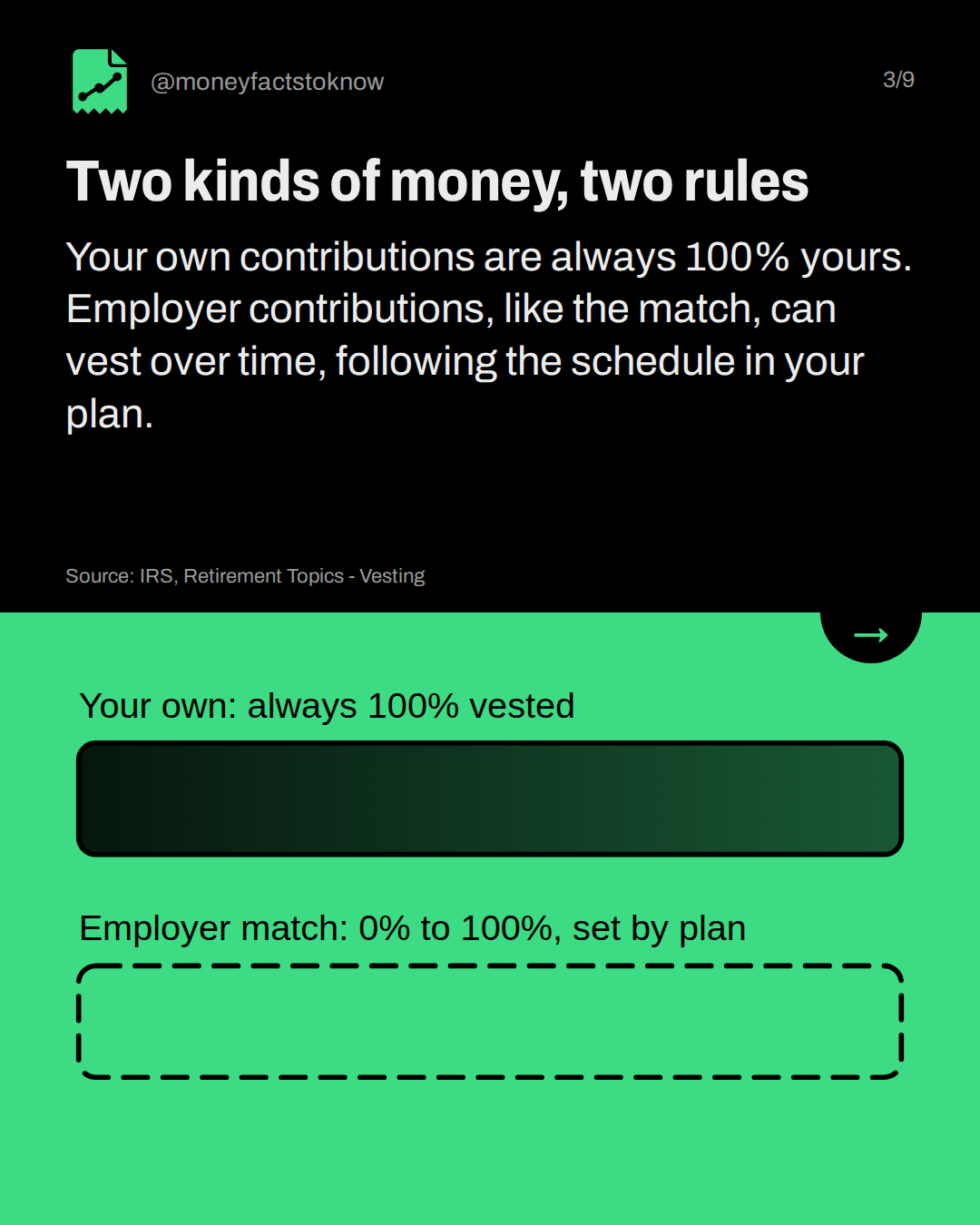
Two kinds of money, two rules
Your own contributions are always 100% yours. Employer contributions, like the match, can vest over time, following the schedule in your plan.
Source: IRS, Retirement Topics - Vesting
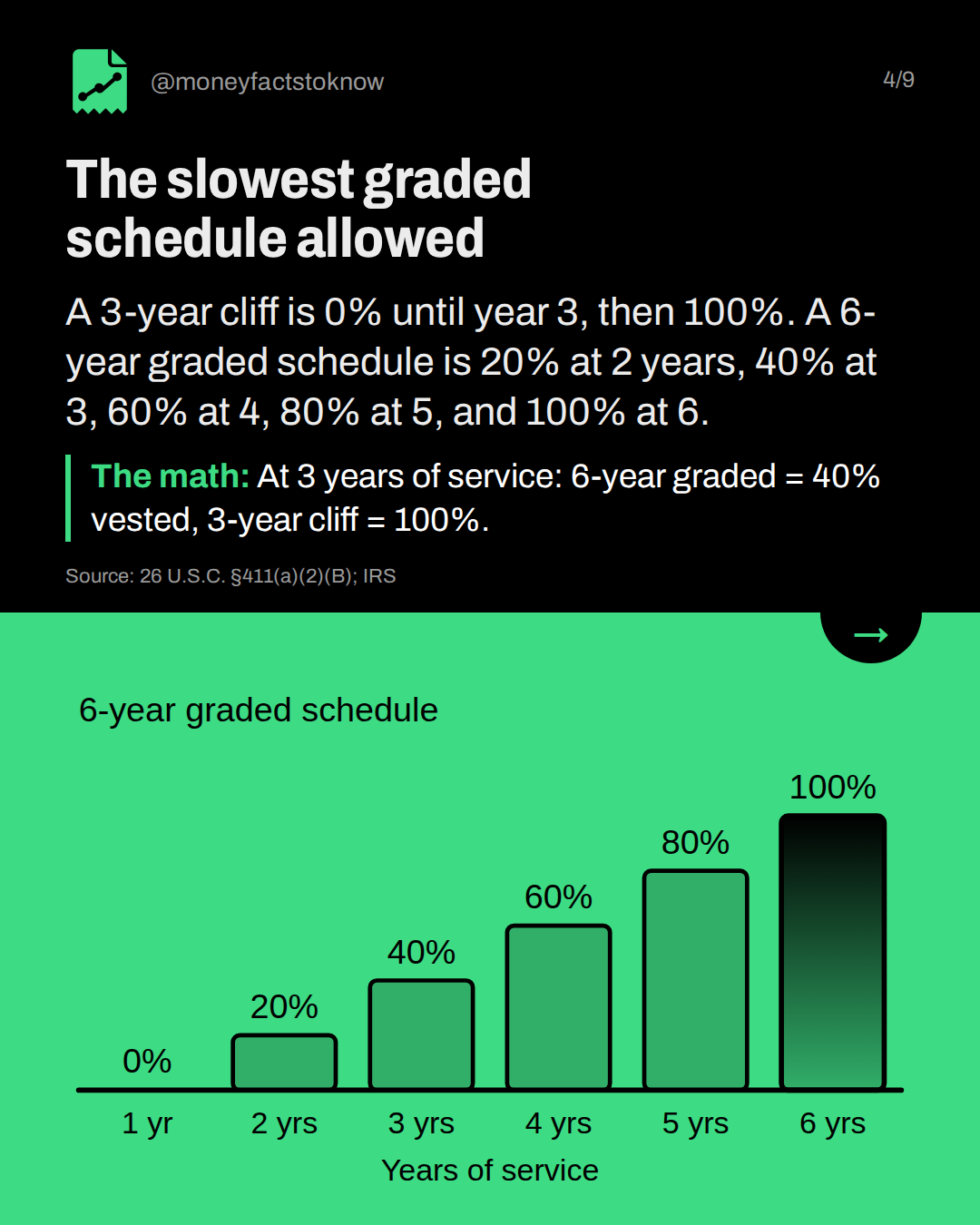
The slowest graded schedule allowed
A 3-year cliff is 0% until year 3, then 100%. A 6-year graded schedule is 20% at 2 years, 40% at 3, 60% at 4, 80% at 5, and 100% at 6.
The math: At 3 years of service: 6-year graded = 40% vested, 3-year cliff = 100%.
Source: 26 U.S.C. §411(a)(2)(B); IRS
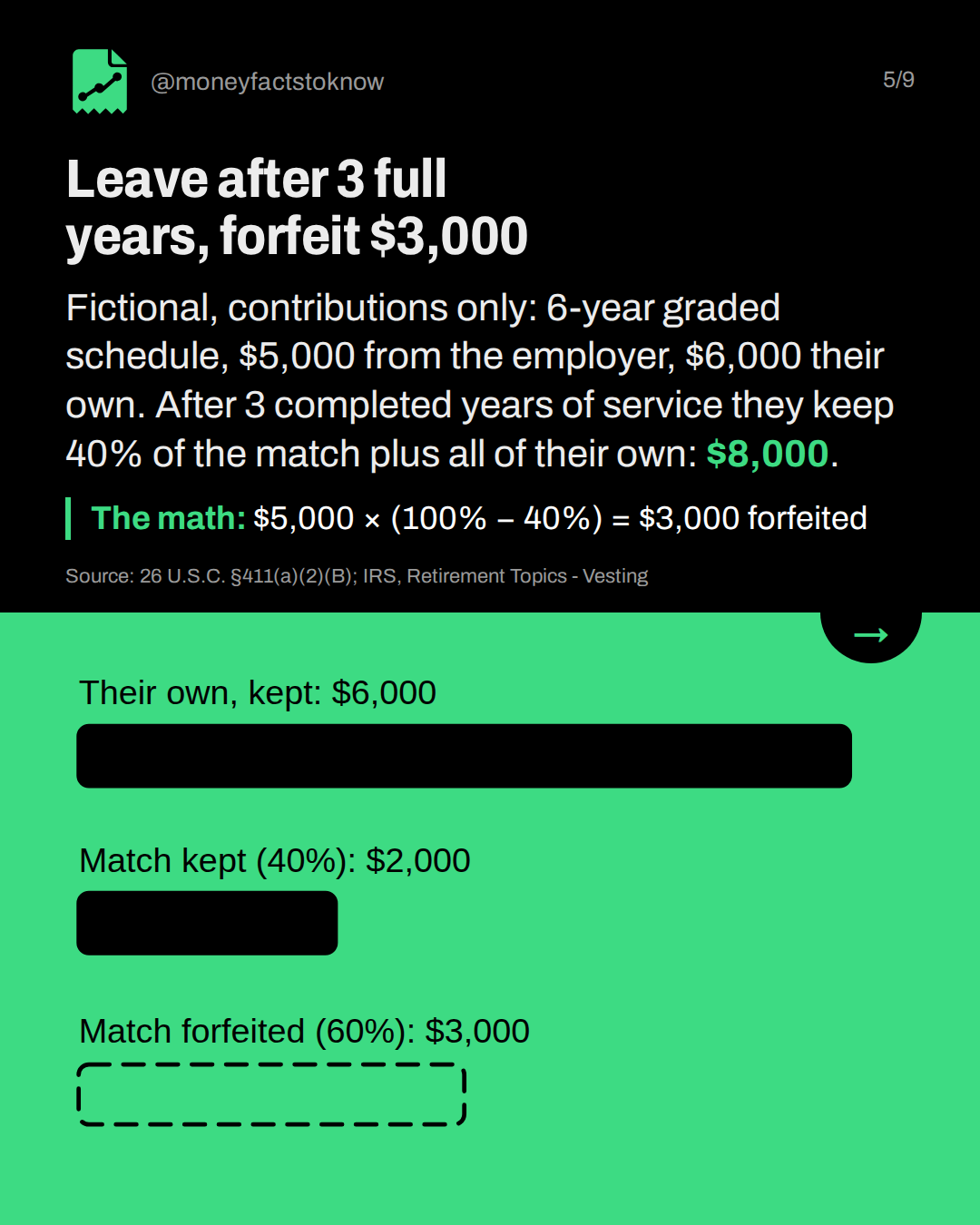
Leave after 3 full years, forfeit $3,000
Fictional, contributions only: 6-year graded schedule, $5,000 from the employer, $6,000 their own. After 3 completed years of service they keep 40% of the match plus all of their own: $8,000.
The math: $5,000 × (100% − 40%) = $3,000 forfeited
Source: 26 U.S.C. §411(a)(2)(B); IRS, Retirement Topics - Vesting
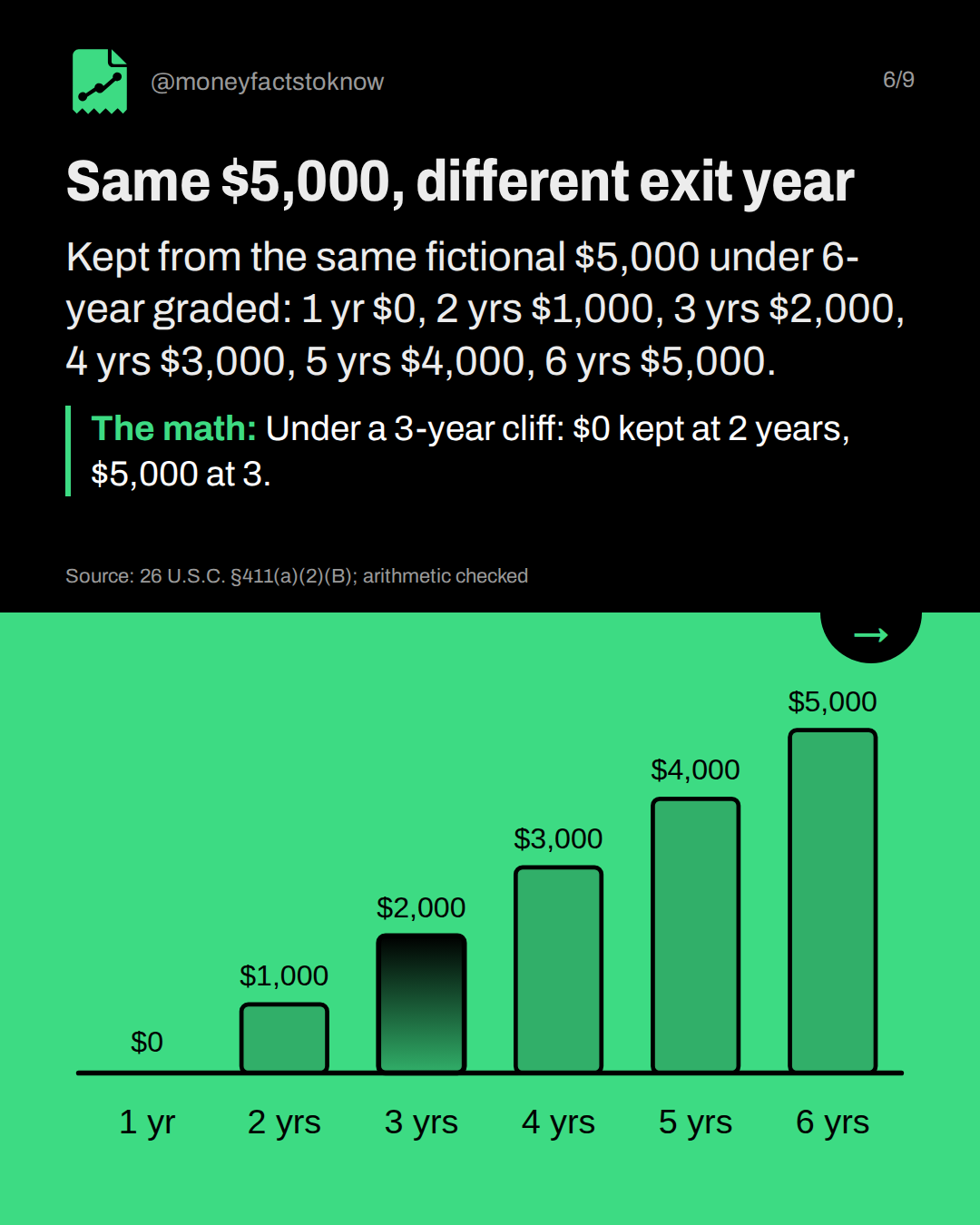
Same $5,000, different exit year
Kept from the same fictional $5,000 under 6-year graded: 1 yr $0, 2 yrs $1,000, 3 yrs $2,000, 4 yrs $3,000, 5 yrs $4,000, 6 yrs $5,000.
The math: Under a 3-year cliff: $0 kept at 2 years, $5,000 at 3.
Source: 26 U.S.C. §411(a)(2)(B); arithmetic checked
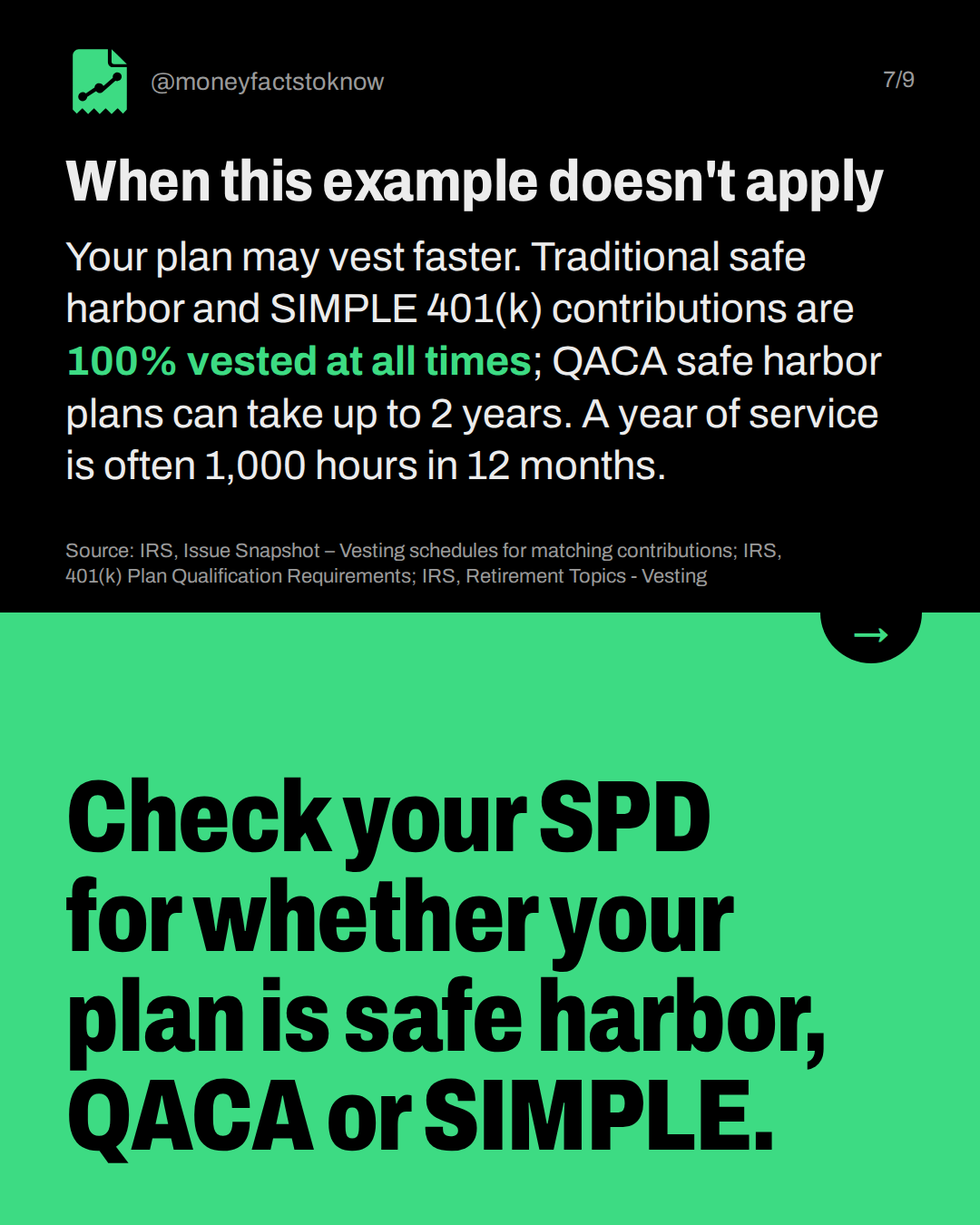
When this example doesn't apply
Your plan may vest faster. Traditional safe harbor and SIMPLE 401(k) contributions are 100% vested at all times; QACA safe harbor plans can take up to 2 years. A year of service is often 1,000 hours in 12 months.
The math: Check your SPD for whether your plan is safe harbor, QACA or SIMPLE.
Source: IRS, Issue Snapshot – Vesting schedules for matching contributions; IRS, 401(k) Plan Qualification Requirements; IRS, Retirement Topics - Vesting
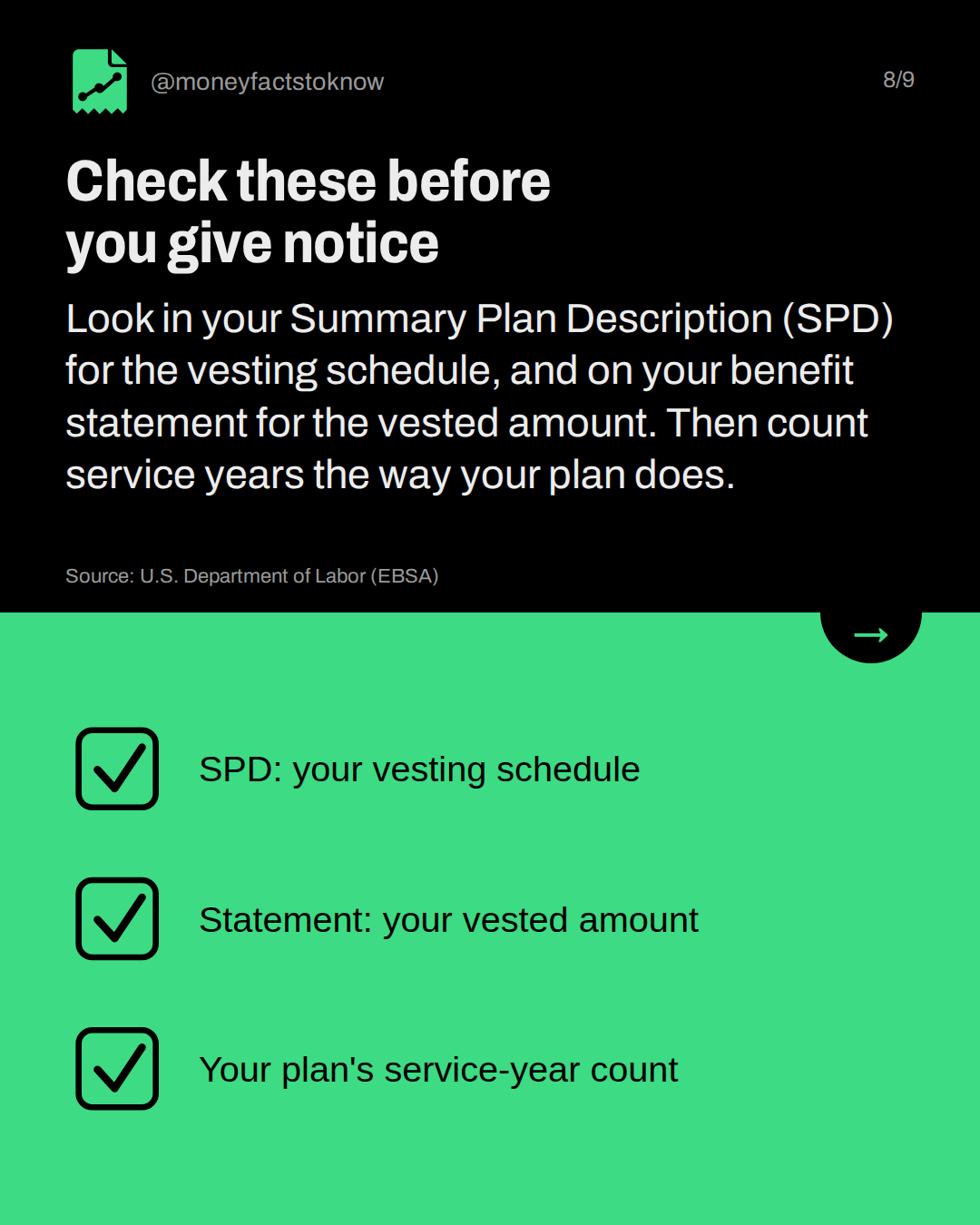
Check these before you give notice
Look in your Summary Plan Description (SPD) for the vesting schedule, and on your benefit statement for the vested amount. Then count service years the way your plan does.
Source: U.S. Department of Labor (EBSA)
Sources and assumptions
- IRS, Retirement Topics - Vesting (page last reviewed 2026-04-08): Employee contributions such as elective deferrals are always 100% vested. 3-year cliff schedule and 6-year graded schedule (20/40/60/80/100% at years 2 to 6). A year of service is generally 1,000 hours in 12 months. 100% vesting at normal retirement age or plan termination. Nonvested amounts may be forfeited when the account is paid out, for example on leaving employment. (checked 2026-10-08)
- 26 U.S. Code §411 (Cornell LII): §411(a)(1): rights from the employee's own contributions are nonforfeitable. §411(a)(2)(B): a defined contribution plan must satisfy either 3-year cliff vesting or 2-to-6-year graded vesting (20% at 2 years, 40% at 3, 60% at 4, 80% at 5, 100% at 6 or more). These are the minimum standards, so plans may vest faster. (checked 2026-10-08)
- IRS, 401(k) Plan Qualification Requirements: Matching contributions must vest at least as fast as a 6-year graded schedule. Elective deferrals are always 100% vested. Safe harbor and SIMPLE 401(k) plans must give 100% vesting in employer and employee contributions at all times. (checked 2026-10-08)
- U.S. Department of Labor (EBSA), What You Should Know About Your Retirement Plan: Definition of vesting (earned the right without risk of forfeiting). The plan's vesting schedule is in the Summary Plan Description, and individual benefit statements show whether you are vested. 401(k) matching contributions use either 3-year cliff or 6-year graduated vesting. Your own contributions are immediately vested. (checked 2026-10-08)
- IRS, Issue Snapshot – Vesting schedules for matching contributions (page last reviewed 2026-06-28): "Matching contributions made to a safe harbor 401(k) plan that is not a Qualified Automatic Contribution Arrangement (QACA) must be 100% vested at all times"; "Matching contributions to a QACA safe harbor 401(k) plan must be 100% vested after a participant completes no more than 2 years of service"; "Matching contributions made to a SIMPLE 401(k) plan must be fully vested when made." Additional matching contributions in safe harbor plans can use the regular §411(a)(2)(B) schedules. (checked 2026-10-08)
- IRS, FAQs – Auto Enrollment – Are there different types of automatic contribution arrangements for retirement plans?: For a QACA: "employees must be 100% vested in the employer's matching or nonelective contributions by two years of service." (checked 2026-10-08)
Assumptions:
- Fictional worker; not a real person or a real plan.
- The plan uses the 6-year graded schedule, the slowest graded schedule federal law allows. Real plans may vest faster or immediately.
- $5,000 of total employer contributions and $6,000 of the worker's own contributions at departure, both fictional.
- Investment gains and losses are ignored; dollar figures are contributions only.
- The worker has exactly 3 completed years of service as the plan defines them (often 1,000 hours in a 12-month period).
- Not a safe harbor or SIMPLE 401(k). Traditional safe harbor and SIMPLE 401(k) contributions are 100% vested at all times; QACA safe harbor contributions must be 100% vested after no more than 2 years of service.
- US federal rules for 401(k) plans as of October 2026.
The short version
- Your own contributions are always 100% yours.
- Employer money can vest over time.
- Fictional 6-year graded: leave at year 3, keep 40%.
- Your plan may vest faster.
- Check your SPD and benefit statement.


