 Money Facts To Know
Breaking a CD early can cost more than the interest it earned

Your worst case isn't just the interest
It's easy to assume the worst case is losing the interest. But a CD is a contract with a fixed amount, a fixed term and an agreed rate, and that contract sets the penalty.
Source: OCC HelpWithMyBank
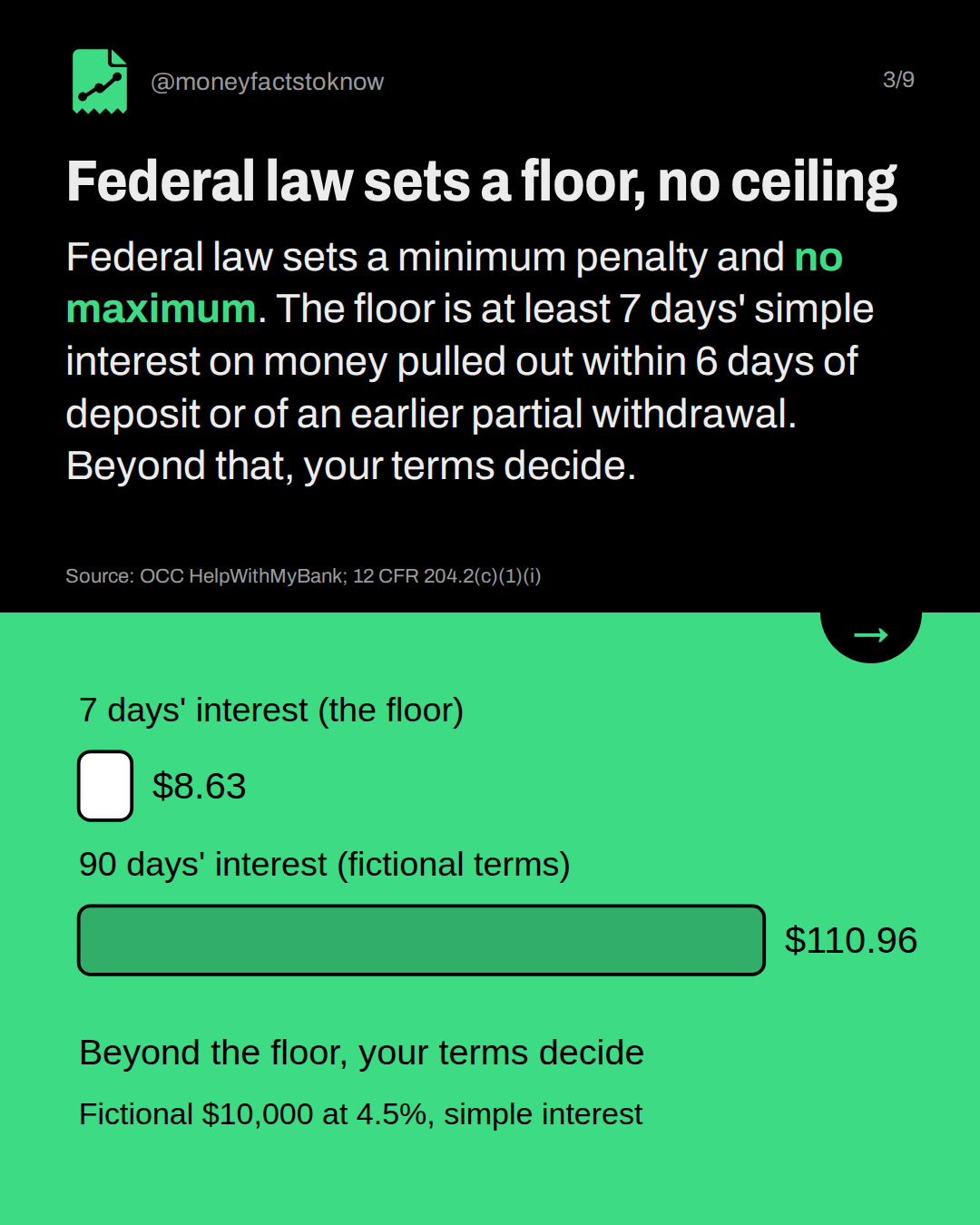
Federal law sets a floor, no ceiling
Federal law sets a minimum penalty and no maximum. The floor is at least 7 days' simple interest on money pulled out within 6 days of deposit or of an earlier partial withdrawal. Beyond that, your terms decide.
Source: OCC HelpWithMyBank; 12 CFR 204.2(c)(1)(i)
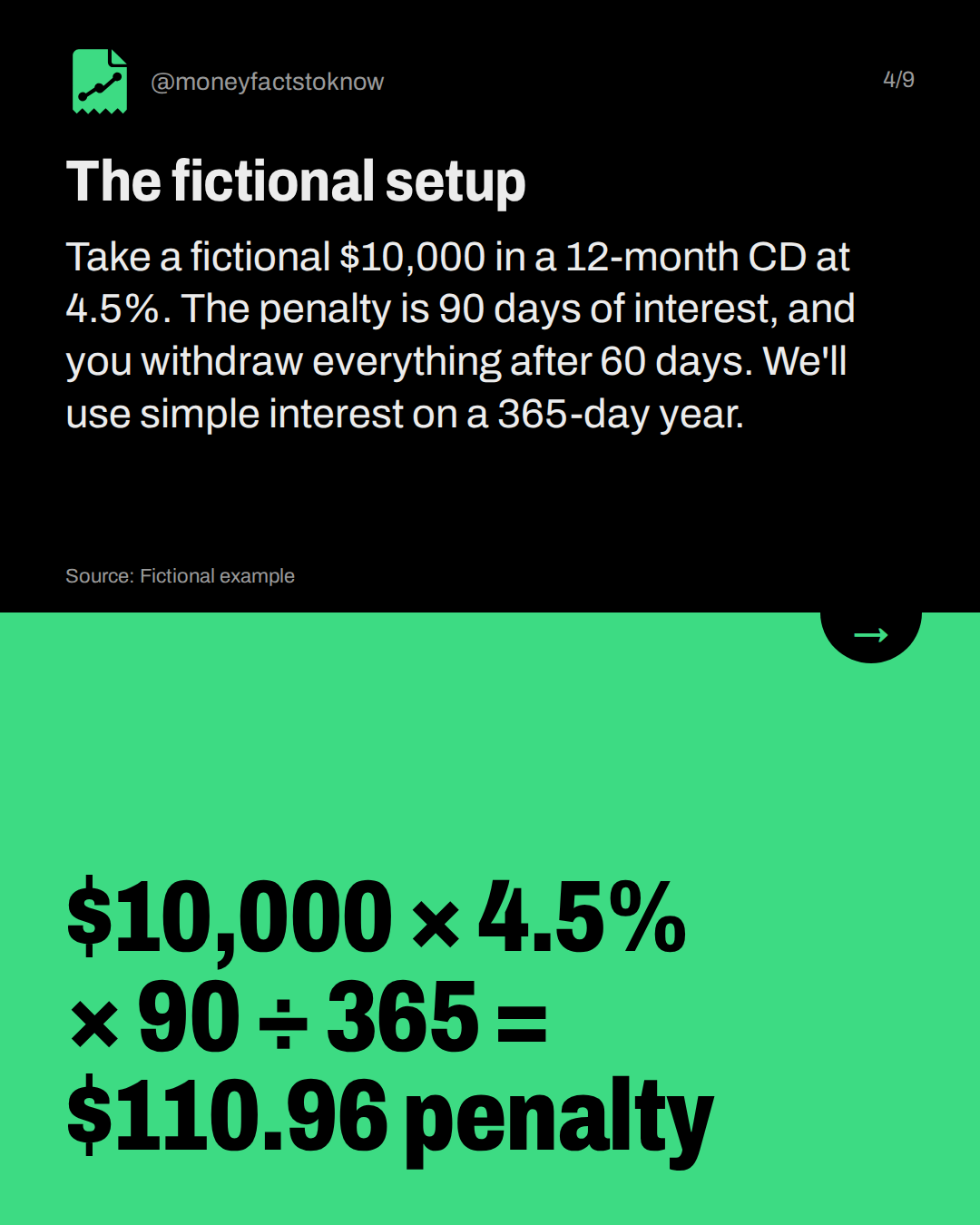
The fictional setup
Take a fictional $10,000 in a 12-month CD at 4.5%. The penalty is 90 days of interest, and you withdraw everything after 60 days. We'll use simple interest on a 365-day year.
The math: $10,000 × 4.5% × 90 ÷ 365 = $110.96 penalty
Source: Fictional example
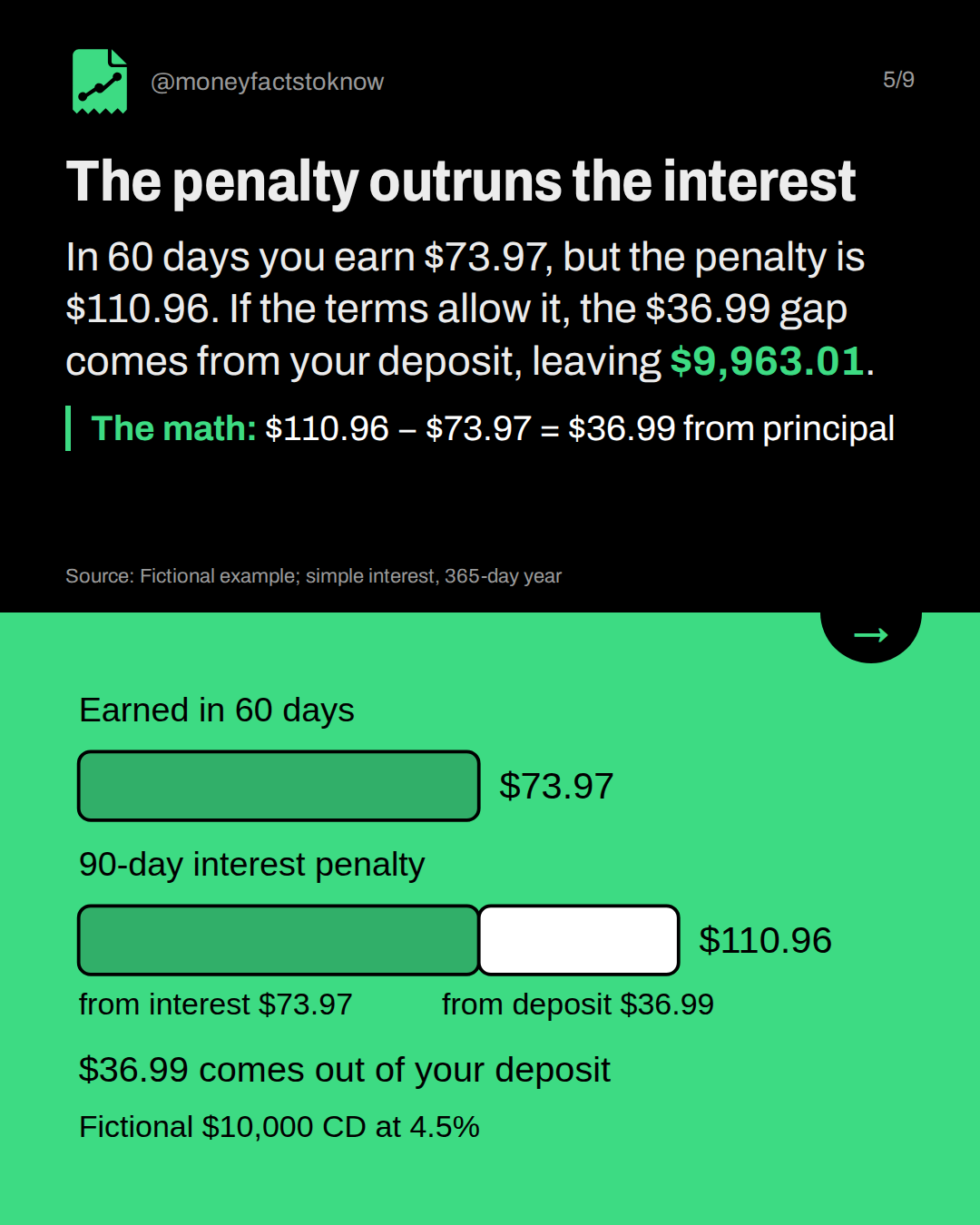
The penalty outruns the interest
In 60 days you earn $73.97, but the penalty is $110.96. If the terms allow it, the $36.99 gap comes from your deposit, leaving $9,963.01.
The math: $110.96 − $73.97 = $36.99 from principal
Source: Fictional example; simple interest, 365-day year
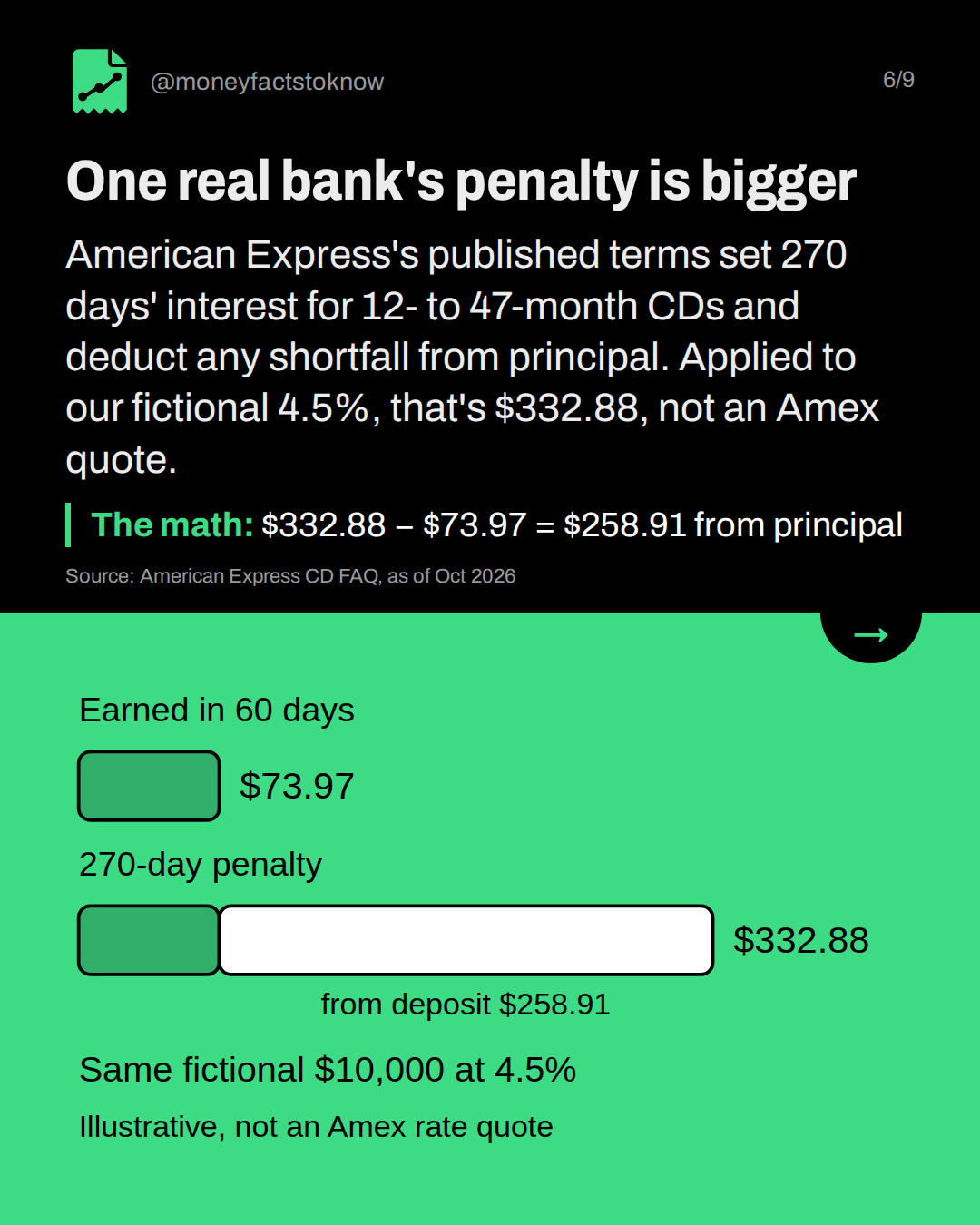
One real bank's penalty is bigger
American Express's published terms set 270 days' interest for 12- to 47-month CDs and deduct any shortfall from principal. Applied to our fictional 4.5%, that's $332.88, not an Amex quote.
The math: $332.88 − $73.97 = $258.91 from principal
Source: American Express CD FAQ, as of Oct 2026
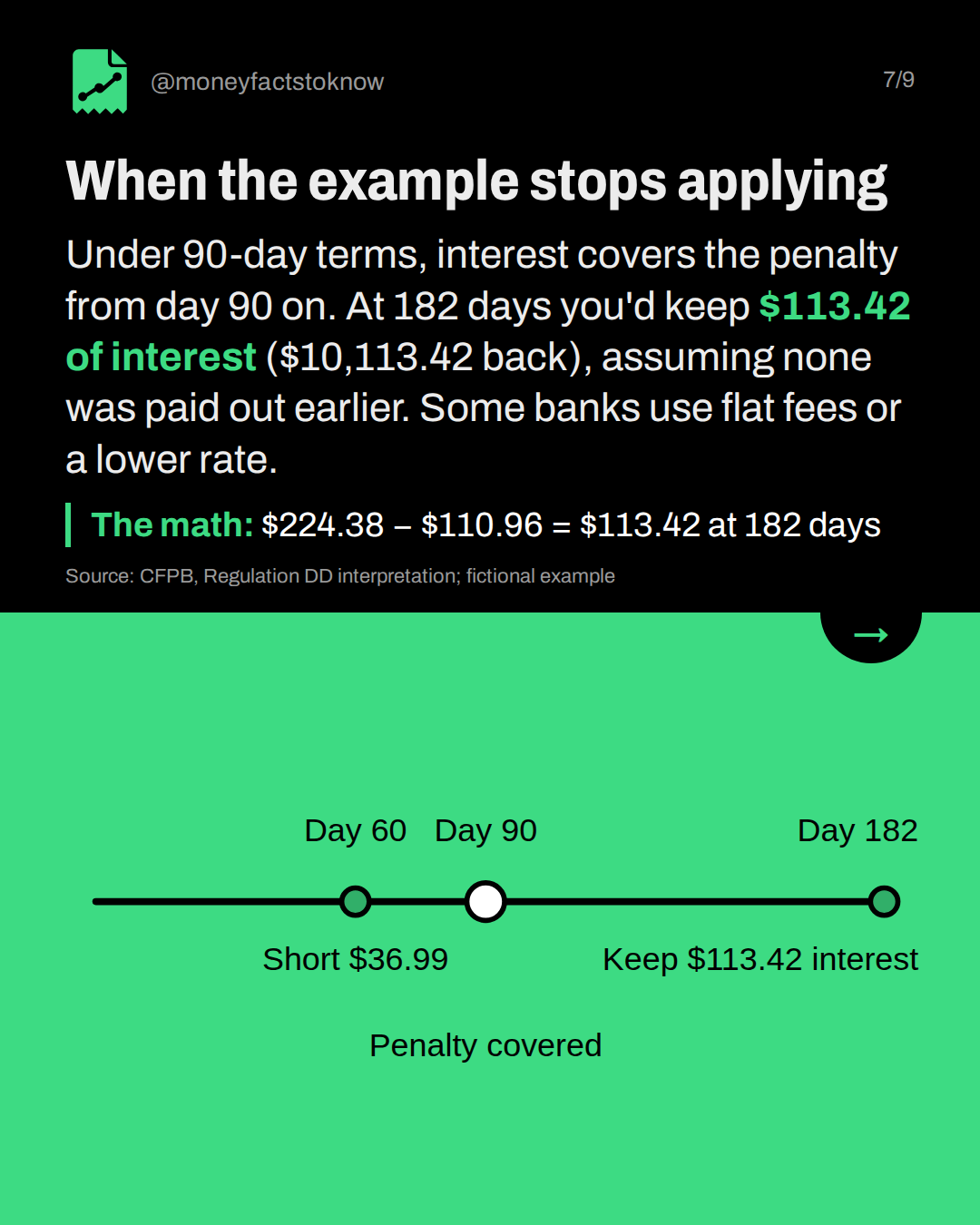
When the example stops applying
Under 90-day terms, interest covers the penalty from day 90 on. At 182 days you'd keep $113.42 of interest ($10,113.42 back), assuming none was paid out earlier. Some banks use flat fees or a lower rate.
The math: $224.38 − $110.96 = $113.42 at 182 days
Source: CFPB, Regulation DD interpretation; fictional example
Check the penalty line first
Find the early withdrawal penalty line in the disclosure. Check the days of interest, the rate, and whether a shortfall can come out of principal. Banks must disclose how it's calculated.
Source: 12 CFR 1030.4 (Truth in Savings)
Sources and assumptions
- OCC HelpWithMyBank.gov: What are the penalties for withdrawing money early from a certificate of deposit (CD)?: "Federal law sets a minimum penalty on early withdrawals from CDs, but there is no maximum penalty. If you withdraw money within the first six days after deposit, the penalty is at least seven days' simple interest." Also: it depends on the terms of your account. (checked 2026-10-07)
- OCC HelpWithMyBank.gov: Can the bank charge me a penalty for withdrawing a CD early?: A CD is a contract for a fixed amount of money (principal) for a predetermined term at an agreed rate. Early withdrawal before maturity triggers a penalty. (checked 2026-10-07)
- 12 CFR 204.2(c)(1)(i), Regulation D, time deposit definition (Cornell LII): A time deposit must carry an early withdrawal penalty of at least seven days' simple interest on amounts withdrawn within the first six days after deposit. This is the only federal floor, and there is no ceiling. (checked 2026-10-07)
- 12 CFR 1030.4(b)(6)(ii), Regulation DD (Truth in Savings) account disclosures (Cornell LII): Banks must disclose 'a statement that a penalty will or may be imposed for early withdrawal, how it is calculated, and the conditions for its assessment', so the penalty is in the account disclosure. (checked 2026-10-07)
- CFPB Regulation DD Official Interpretation, comment 4(b)(6)(ii): Penalties can be monetary (a fixed dollar amount or a number of days' interest), adverse changes to terms (a lower rate or APY on the remaining funds), or reclaiming a bonus. (checked 2026-10-07)
- American Express National Bank FAQ: early withdrawal from a CD: Terms under 12 months: 90 days' interest. 12 to under 48 months: 270 days' interest. 48 to under 60 months: 365 days' interest, all on the withdrawn amount at the disclosed rate. 'If the amount of the penalty is greater than the available interest earned or credited on your CD, we will deduct the difference from your principal.' Penalties may be waived, e.g. on the death or incompetence of an account holder. (checked 2026-10-07)
Assumptions:
- Fictional CD: $10,000 deposit, 12-month term, 4.5% interest rate, penalty = 90 days of interest on the amount withdrawn at the CD's rate.
- The whole $10,000 is withdrawn after exactly 60 days.
- Interest and penalty use simple interest on a 365-day year: amount × rate × days / 365. Real CDs usually compound daily or monthly. With daily compounding, 60 days earns $74.24 and 90 days of interest is $111.57, so the principal hit stays about $37.
- No interest has been paid out of the CD before the withdrawal, so all earned interest is available to offset the penalty.
- The American Express comparison applies its published 270-day rule for 12- to 47-month terms to the same fictional $10,000 at 4.5%. That is not an American Express rate quote.
- Taxes on the interest are ignored. Federal rules as of October 2026.
The short version
- A CD penalty comes from your account terms
- Federal law sets no maximum
- Here, 90 days' interest beat 60 days earned
- A shortfall can come out of principal
- Check the penalty line in the disclosure


