 Money Facts To Know
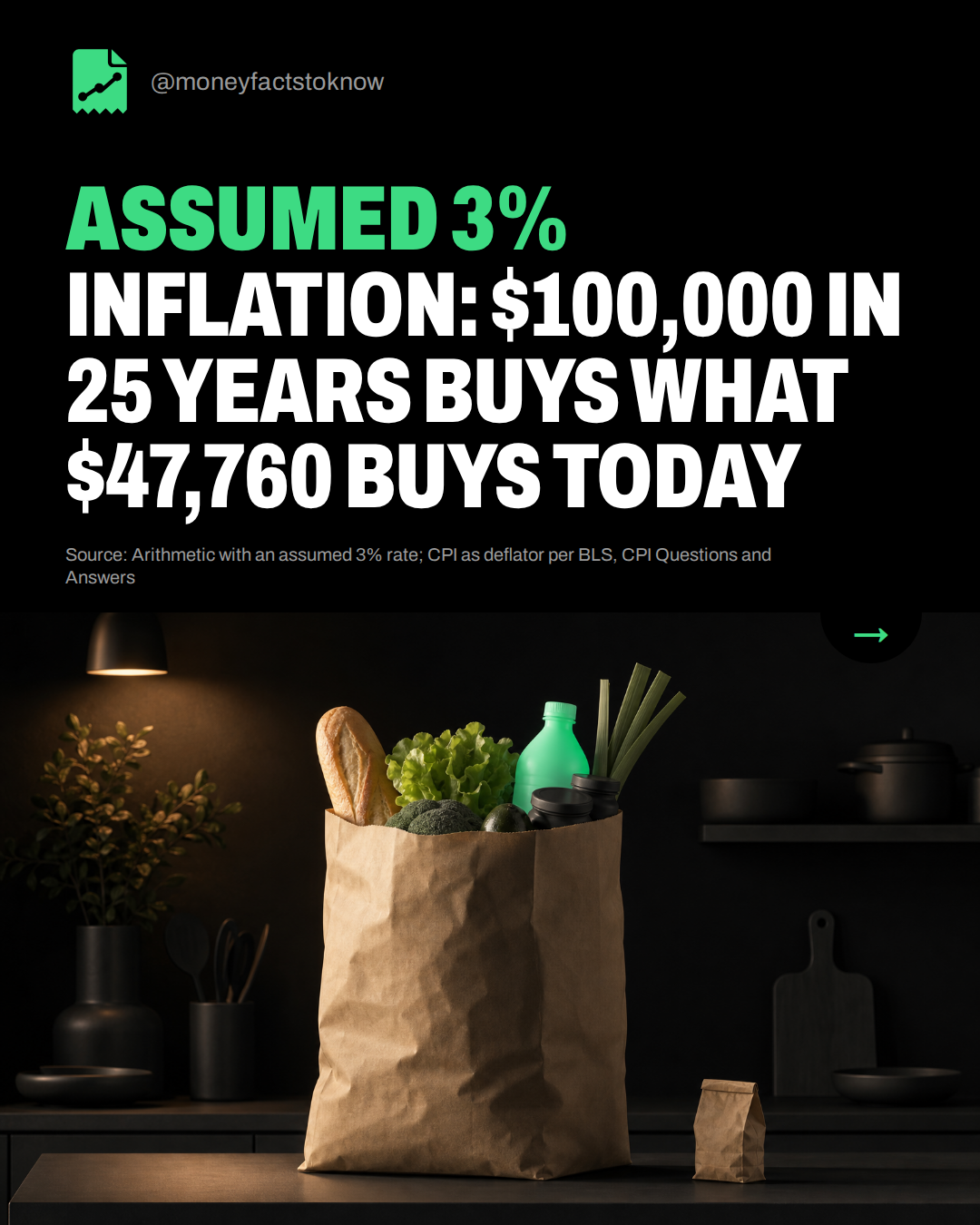
Assumed 3% inflation: $100,000 in 25 years buys what $47,760 buys today
A future $100,000 isn't today's
It's easy to picture a future $100,000 as $100,000 of today's groceries, rent and cars. But inflation means prices rise, so the same dollars buy less later.
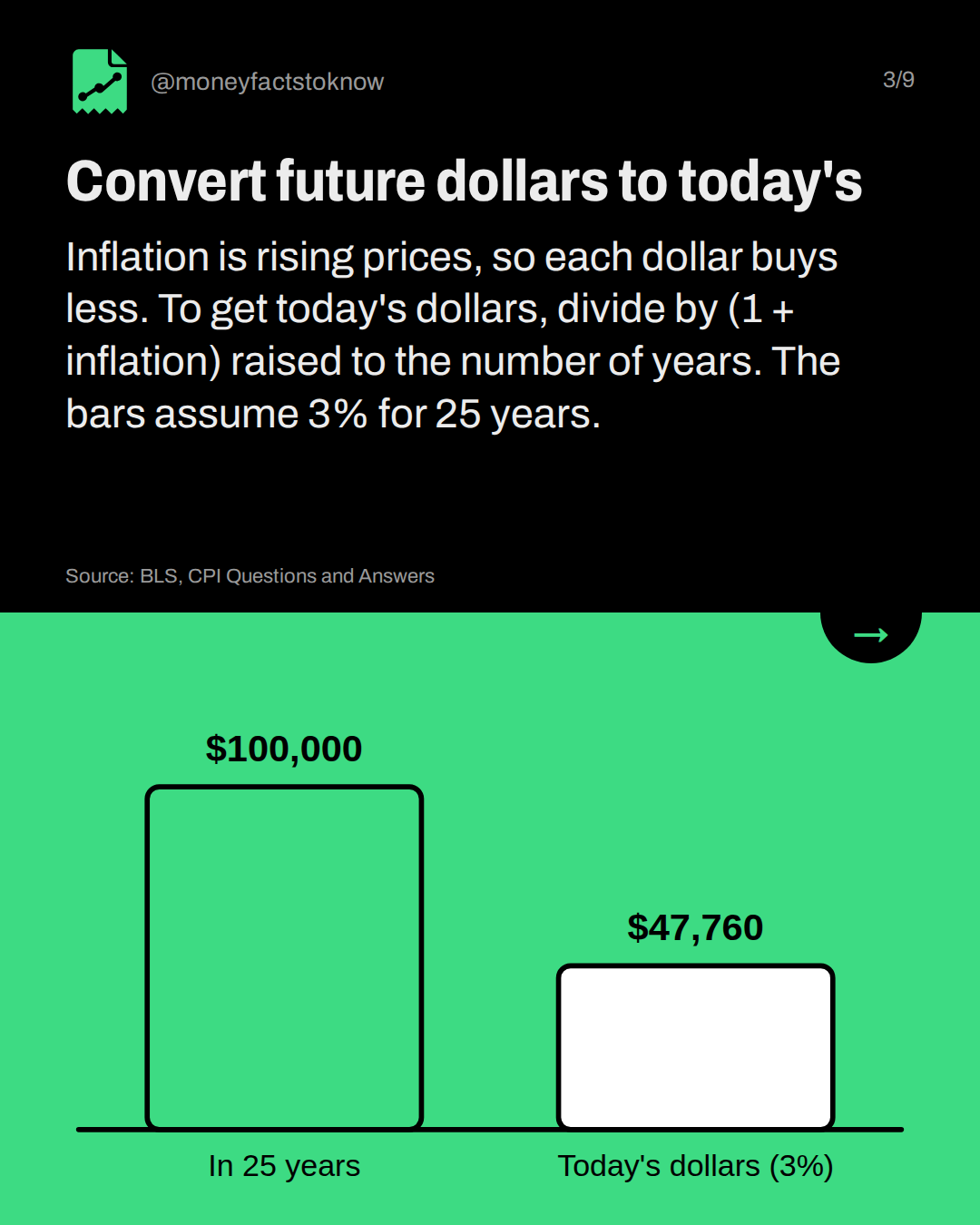
Convert future dollars to today's
Inflation is rising prices, so each dollar buys less. To get today's dollars, divide by (1 + inflation) raised to the number of years. The bars assume 3% for 25 years.
Source: BLS, CPI Questions and Answers
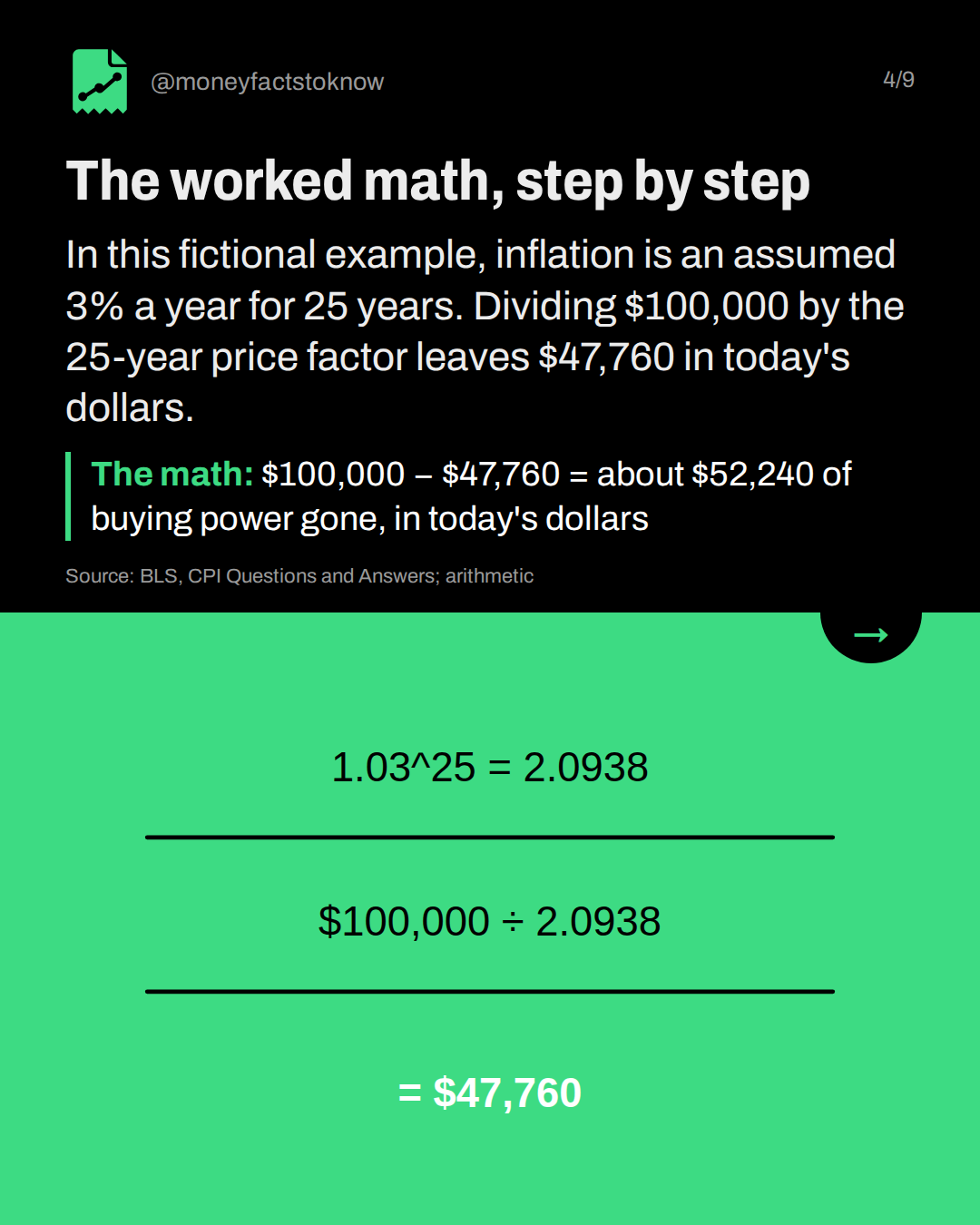
The worked math, step by step
In this fictional example, inflation is an assumed 3% a year for 25 years. Dividing $100,000 by the 25-year price factor leaves $47,760 in today's dollars.
The math: $100,000 − $47,760 = about $52,240 of buying power gone, in today's dollars
Source: BLS, CPI Questions and Answers; arithmetic
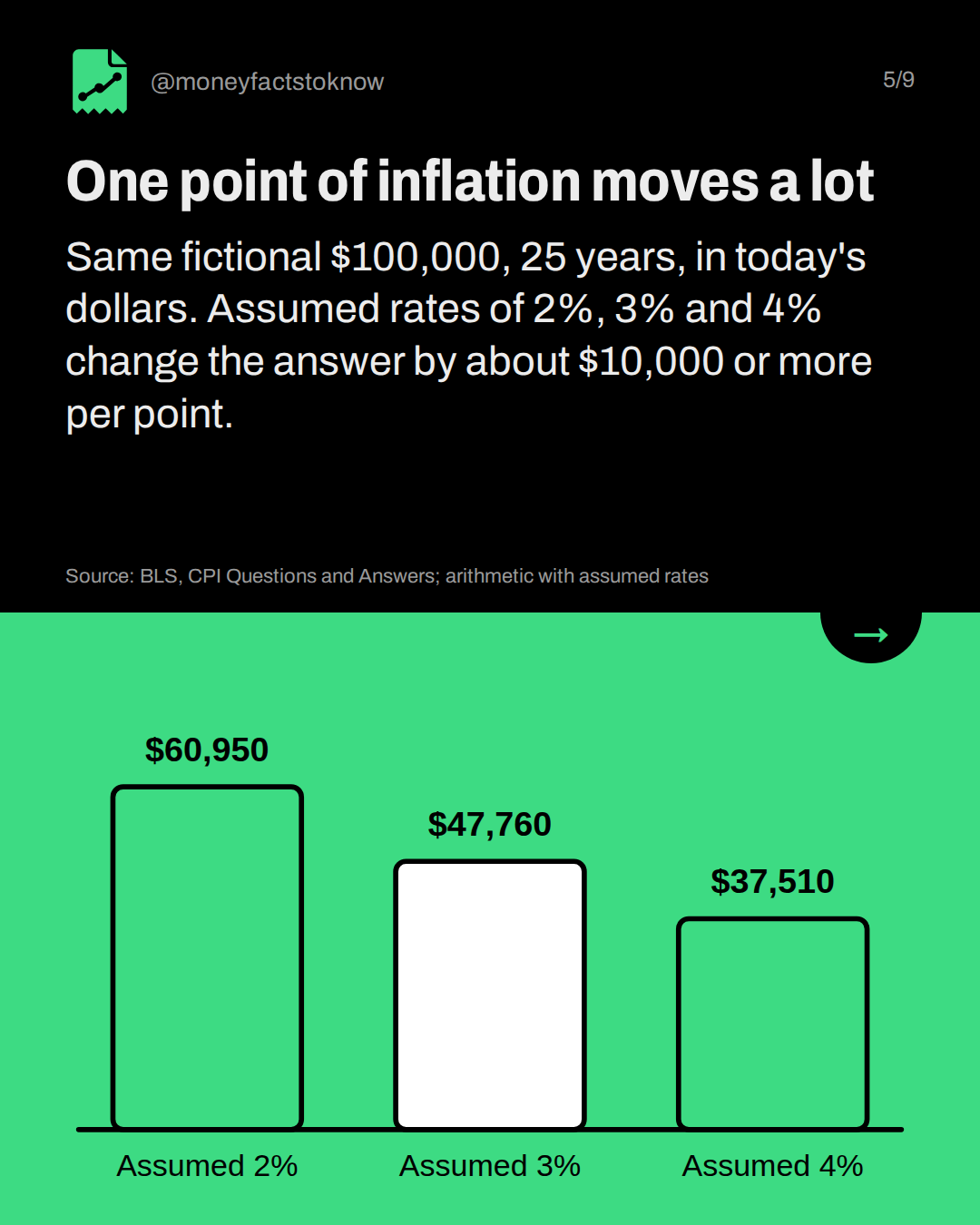
One point of inflation moves a lot
Same fictional $100,000, 25 years, in today's dollars. Assumed rates of 2%, 3% and 4% change the answer by about $10,000 or more per point.
Source: BLS, CPI Questions and Answers; arithmetic with assumed rates
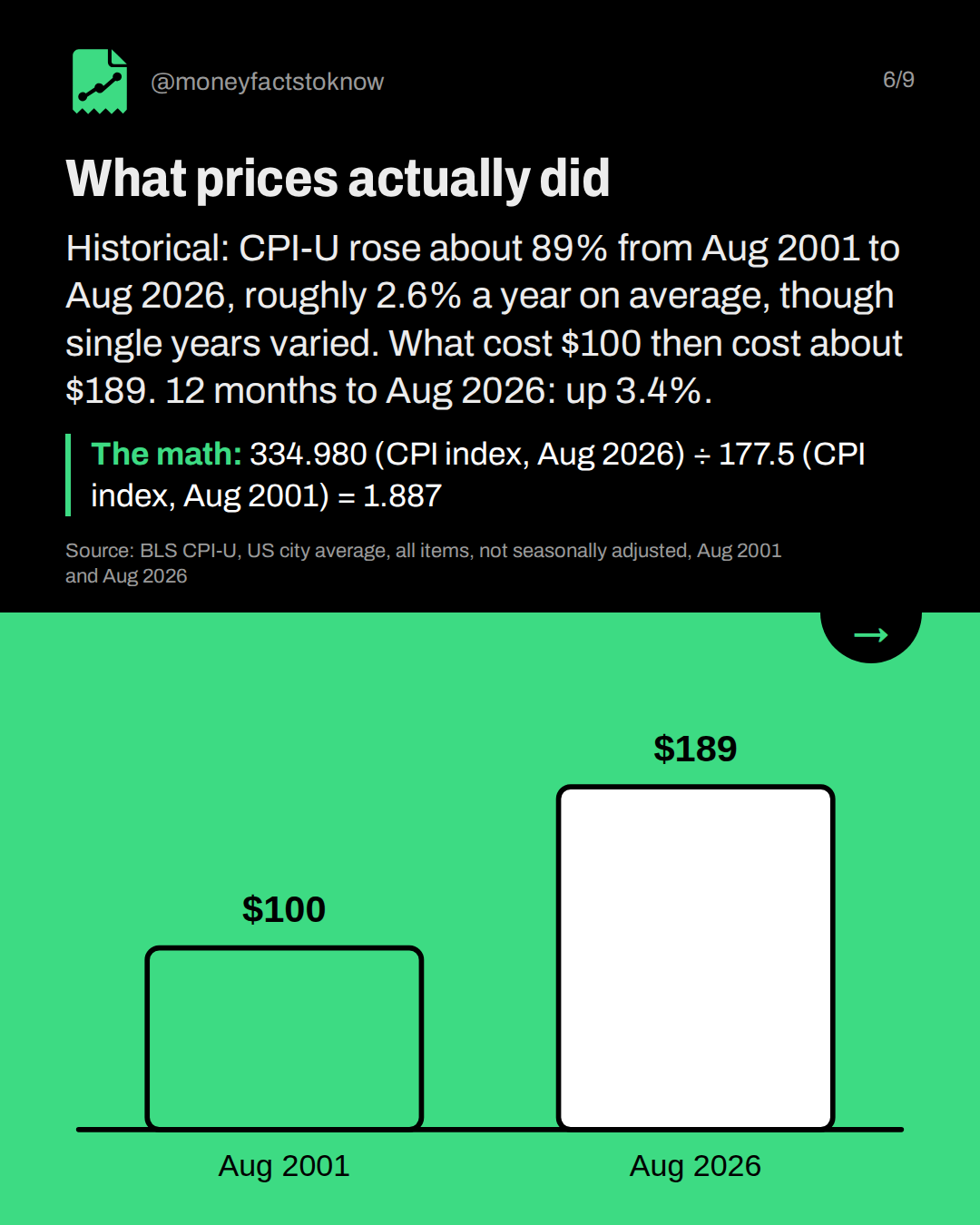
What prices actually did
Historical: CPI-U rose about 89% from Aug 2001 to Aug 2026, roughly 2.6% a year on average, though single years varied. What cost $100 then cost about $189. 12 months to Aug 2026: up 3.4%.
The math: 334.980 (CPI index, Aug 2026) ÷ 177.5 (CPI index, Aug 2001) = 1.887
Source: BLS CPI-U, US city average, all items, not seasonally adjusted, Aug 2001 and Aug 2026
When this math stops applying
BLS says the CPI "does not necessarily measure your own experience with price change." Your own inflation can be higher or lower. The conversion also ignores taxes, raises and investment growth.
Source: BLS, CPI Questions and Answers
Check which dollars you're seeing
Ask whether a future goal is nominal (face value, not adjusted for inflation) or in today's dollars. To convert, divide by (1 + a rate you choose) raised to the number of years.
Source: BLS, CPI Questions and Answers
Sources and assumptions
- BLS, Consumer Price Index News Release, August 2026 (released Sept 11, 2026): CPI-U increased 3.4% over the 12 months ending August 2026 (not seasonally adjusted), to an index level of 334.980 (checked 2026-10-07)
- BLS Public Data API, series CUUR0000SA0 (CPI-U, US city average, all items, NSA, 1982-84=100), 2001: CPI-U index for August 2001 = 177.5 (checked 2026-10-07)
- BLS, Consumer Price Index: Questions and Answers: CPI definition ('average change over time in the prices paid by consumers for a representative basket'); 'The CPI does not necessarily measure your own experience with price change'; CPI is used as a deflator to find the dollar's purchasing power (checked 2026-10-07)
Assumptions:
- The 3% annual inflation rate is an assumption for illustration, not a forecast or a historical average; the 2% and 4% alternatives are assumptions too.
- Inflation is assumed constant and compounded once a year for 25 years.
- The $100,000 is a fictional future nominal amount; the calculation converts it to today's dollars only and ignores taxes, investment returns, raises and fees.
- Historical figures use CPI-U, US city average, all items, not seasonally adjusted, August 2001 (177.5) to August 2026 (334.980); a personal inflation rate can differ.
- Results are rounded to the nearest $10 on the slides.
The short version
- A future dollar amount buys less than today's
- Divide by (1 + rate) raised to the years
- Assumed 3%, 25 years: $100,000 ≈ $47,760 today
- Measured: prices up about 89% since Aug 2001
- Your own inflation can differ